


By | Editorial Team
Introduction
Nigeria continues to debate the creation of state police as part of efforts to reform the national security structure. The present policing framework is centralised under the Nigeria Police Force and supervised by the Federal Government. Rising insecurity across several regions, including banditry, terrorism, kidnapping and communal violence, has renewed calls for decentralised policing.

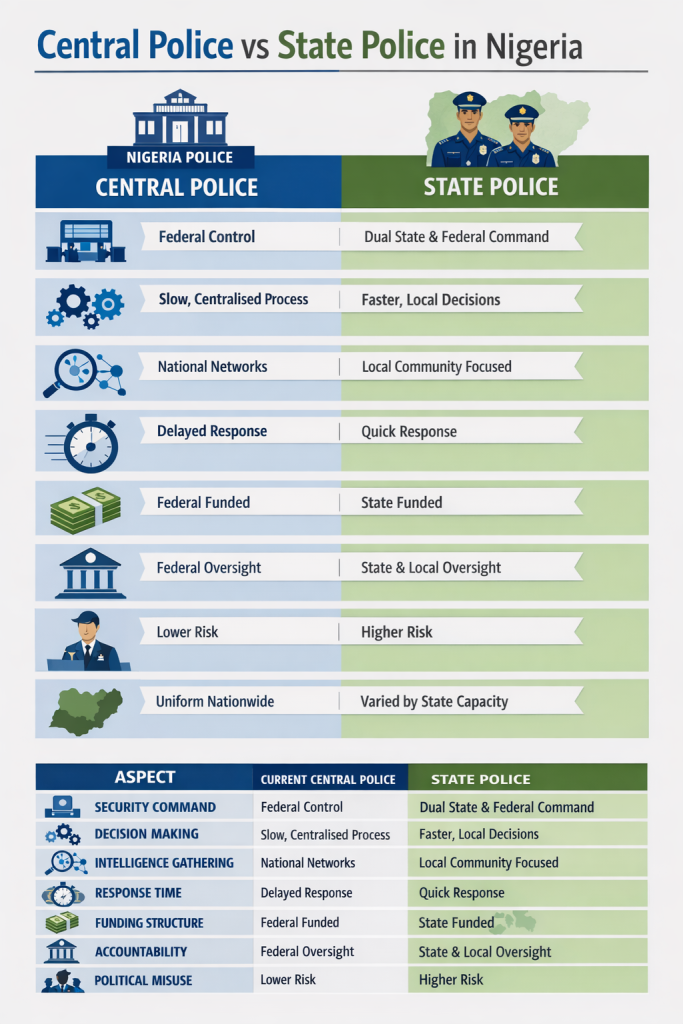
Supporters believe state police would improve response time, strengthen intelligence gathering and deepen accountability at the local level. Critics warn that political actors at the state level may abuse such structures. The proposal therefore carries significant implications for security, governance, fiscal management and federalism in Nigeria.
Historical Context of Policing in Nigeria
Nigeria operated regional police forces during the First Republic. Regional governments controlled these forces alongside a national police structure. Political interference in regional police operations later raised concerns about abuse of authority.
Following the military intervention of 1966, the regional police system was abolished and replaced with a unified national police structure. The centralised model aimed to strengthen neutrality and national unity. However, it has struggled to cope with Nigeria’s growing population, geographic size and complex security challenges.
Security Implications
A key argument for state police relates to operational effectiveness. Local security institutions often understand terrain, language and social networks better than central command structures.
State police units could detect early warning signals of conflict or criminal activity. They could also respond faster because command authority would exist closer to the incident location.
However, decentralisation carries risks. Political leaders may attempt to influence police operations. In states where institutions remain weak, police units could be used to intimidate opponents or manipulate electoral processes.
Fiscal and Administrative Implications
Establishing state police would require substantial financial commitments from state governments. These costs include recruitment, training, equipment, infrastructure and operational logistics.
Many Nigerian states depend heavily on federal allocations. Limited internally generated revenue may affect their ability to maintain effective policing institutions. Wealthier states may build stronger police organisations while financially weaker states may struggle.
Administrative coordination between federal and state security agencies would also require clear legal frameworks and operational guidelines.
Political and Governance Implications
State police would reshape Nigeria’s governance structure. Governors would gain greater authority over security within their states. Advocates argue this would align responsibility with accountability because citizens would judge state governments based on security outcomes.
Concerns remain about the concentration of power in the hands of state executives. Without strong institutional checks, police institutions may become instruments of political control. Independent oversight and strong legal safeguards would therefore be essential.
Impact on Federalism
The debate on state police connects closely with Nigeria’s broader federalism discussion. Decentralised policing could strengthen subnational governance and allow states to develop solutions suited to their security realities.
At the same time, a strong federal police structure would still be necessary to manage terrorism, organised crime and cross state criminal networks. Effective cooperation between federal and state security agencies would remain essential.
Possible Safeguards for Implementation
- If Nigeria adopts state police, several safeguards would be necessary.
- Clear constitutional provisions defining jurisdiction between federal and state police.
- Independent state police service commissions responsible for recruitment and discipline.
- Professional training standards that align with national policing doctrine.
- Transparent funding structures to ensure operational sustainability.
- Strong judicial and legislative oversight to prevent political interference.
Conclusion
The proposal for state police represents a major institutional reform within Nigeria’s security system. The debate reflects growing concern that the present centralised structure struggles to address diverse security threats across the country.
State police could improve intelligence gathering, response time and community trust. However, the reform also introduces risks relating to political influence and uneven financial capacity among states.
The outcome will depend on the legal framework, institutional safeguards and governance standards that guide implementation. A carefully designed structure that balances decentralisation with accountability will determine whether state police strengthens or weakens Nigeria’s security environment.
Comparative Responsibilities Under Central and State Policing