



By | Destiny Young
Nigeria has made credential verification harder to ignore. Graduates now need a certificate from the Nigerian Education Repository and Databank (NERD) to register for the National Youth Service Corps.
I support this direction. I also think Nigeria must fix the operational gaps fast, or this policy will punish genuine graduates while the underlying university bottlenecks remain.
My experience, and why this matters
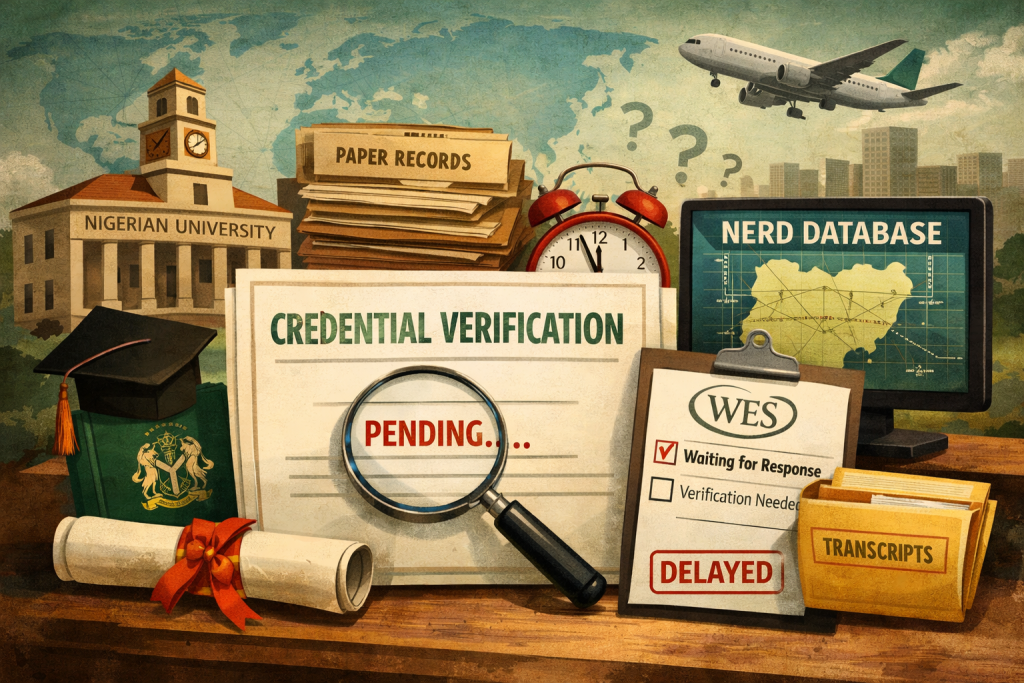
I have had difficulty getting my Nigerian qualifications verified for use with foreign institutions. The most frustrating part is not the foreign evaluator’s process. The real constraint is the response behaviour of Nigerian institutions.
My worst experience came from a credential evaluation request with WES. WES relies on its standard verification protocol for proof of authenticity. Up until today, the university I attended in Nigeria has not replied to WES enquiries to confirm my qualification. That single silence stalled the entire process.
This is the lived reality for many Nigerian graduates. Your certificate can be genuine and your request can be valid, but your opportunity still depends on whether an office replies, and when.
The structural weakness inside Nigerian universities
Most universities in Nigeria still lack a complete electronic academic record management process that runs from admission through graduation, transcript issuance, and third party verification. Records often sit in manual systems and disconnected departmental workflows. That makes verification slow and error prone.
A second weakness is the absence of standard timelines. Many institutions do not publish clear service turnaround times for transcript processing and credential confirmation. Graduates do not get tracking, predictable escalation, or accountability.
Nigeria wakes up, but this is the part that still worries me
Linking verification to NYSC is a strong enforcement move. It signals that Nigeria wants one national standard for confirming credentials.
But enforcement alone is not reform. The reform only succeeds if Nigeria makes it easy for genuine graduates to comply, and hard for institutions to delay or ignore verification requests.
What Nigeria should fix next
Nigeria should mandate complete digital student record systems across accredited institutions, with audit ready data quality.
Nigeria should set national service timelines for transcript processing and third party verification replies, with penalties for persistent non compliance.
Nigeria should implement a clear escalation path for graduates when a school fails to respond, so a person’s future is not trapped in an unanswered inbox.
Nigeria should design verification outputs that foreign credential evaluators can accept consistently, so verification becomes routine, not improvised.
My view
Nigeria has started the right journey by making verification a national priority and tying it to NYSC mobilisation.
Now Nigeria must solve the hard part, institutional record systems, response discipline, and service timelines. Until that happens, national verification will exist in policy, while graduates still lose opportunities because their universities cannot, or will not, confirm the truth.
Destiny Young, writes from Uyo