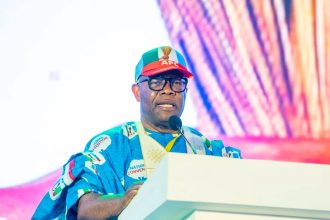




The ruling party (APC) gathers to reset its structure and renew its message, the convention presents a chance to project unity, consolidate power and prepare for the decisive road to 2027.
By | Destiny Young
As the All Progressives Congress converges for its national convention, it does so as the political party that has most clearly shaped the direction of Nigeria’s democratic journey in the last decade. This is not just another gathering of delegates, party officers and stakeholders. It is a moment of renewal, a moment of reflection and a moment of political affirmation for a party that has carried the burden of national leadership and remains central to the future of governance in Nigeria.

The APC occupies a unique place in the country’s democratic history. Its emergence changed the structure of power in Nigeria. It brought together major opposition forces, forged a national coalition and achieved what once seemed difficult in the country’s political evolution. It defeated an incumbent ruling party at the centre and, in doing so, gave stronger meaning to democratic competition. That achievement alone secured its place in history. It proved that political power in Nigeria could be won through organisation, vision, coalition-building and the ballot.
That foundation still matters today. The APC was not built as a narrow political vehicle. It was built as a broad national movement with the capacity to unite tendencies, regions and interests around the idea of a stronger and more competitive Nigeria. From its earliest days, it demonstrated courage, patience and strategic discipline. It understood that national leadership demands more than rhetoric. It demands structure, staying power and the ability to translate popular aspiration into workable political organisation.
Its journey has not been without challenges. No serious ruling party escapes internal contest, pressure and moments of strain. The APC has faced all of these. It has managed leadership transitions, weathered internal disagreements and endured the pressures that come with governing a country as complex as Nigeria. Yet the party has remained standing, strong and relevant. That resilience is not a weakness in its story. It is one of its finest credentials. It shows a party with depth, flexibility and the political intelligence to survive difficult moments without losing national direction.
The APC’s leadership journey also reflects that institutional strength. Over time, the party has renewed itself through changing circumstances and changing demands. It has continued to produce leaders, rebuild consensus and preserve its broad national identity. That ability to regenerate is one reason the party remains the dominant force in Nigerian politics. It has shown that it is not defined by one moment, one tendency or one personality alone. It is defined by continuity, scale and a capacity to adapt.
That is why this national convention matters. A convention is not only about selecting officers or affirming party structures. It is about sending a message. It is about demonstrating confidence, order and readiness. It is about proving that the ruling party remains in command of its purpose and fully aware of its responsibility to the nation. The APC has before it the opportunity to show Nigerians that it is not tired, not divided and not uncertain about the future. It has the opportunity to show that it remains the party with the clearest structure, the widest reach and the strongest instinct for national leadership.
As the country moves towards the 2027 election, the task ahead is clear. The APC must deepen unity within its ranks, strengthen confidence among its supporters and present itself not merely as the party in power, but as the party best equipped to preserve stability, sustain democratic growth and move Nigeria forward. Nigerians expect leadership that is steady, organised and purposeful. They expect political maturity, not confusion. They expect direction, not drift. The APC is still the party best positioned to provide that direction.
The future it holds for Nigeria depends on how firmly it embraces this moment. If the APC uses this convention to consolidate its strength, sharpen its message and reinforce internal discipline, it will enter the next electoral cycle from a position of real advantage. It already has what most parties struggle to build: national presence, governing experience, tested structures and enduring relevance. What it needs now is to convert these assets into fresh momentum and a renewed democratic mandate.
There is also a larger national question at stake. Nigeria’s democracy needs strong parties. It needs parties with roots, memory, internal order and governing capacity. The APC has shown that it possesses these features. In many ways, its endurance has helped steady the democratic system itself. At a time when political fragmentation often threatens coherence, the APC continues to offer Nigerians the image of a party capable of holding together diverse interests under one national platform.
That should not be taken lightly. A party that has moved from opposition coalition to governing institution, and has remained competitive through changing seasons, has already shown uncommon political strength. The APC must now build on that strength with humility, confidence and renewed commitment to the national interest. It must show that experience in power has made it wiser, stronger and more prepared for the responsibilities ahead.
This is the real meaning of the convention. It is not a ceremony. It is a statement. It is the party’s chance to remind the country why it rose, why it endured and why it still matters. It is the APC’s opportunity to reassure supporters, energise stakeholders and project a compelling vision of continuity, reform and democratic stability.
As 2027 approaches, the APC stands before another defining test. The road ahead will require unity, strategic clarity and disciplined leadership. But if its history is any guide, this is a party that understands how to rise to defining moments. From coalition to victory, from challenge to resilience, from transition to continuity, the APC has repeatedly shown that it is built for the long distance.
The national convention should therefore be seen for what it is: a rallying point for renewal, a platform for consolidation and a reminder that the APC remains the party with the strongest claim to shape Nigeria’s next democratic chapter.
As 2027 draws nearer, the APC has little reason to approach this convention with hesitation. It is the party that broke old electoral assumptions, took power through democratic means and has remained the central force in Nigeria’s political life. Now it must show that it still has the discipline to lead, the unity to endure and the vision to carry the country forward. If this convention delivers clarity, strength and renewed purpose, the APC will not only leave Abuja stronger, it will stand better placed to define the next phase of Nigeria’s democratic journey.
—-
Destiny Young, writes from Uyo