

By | Ekaette Okon-Joseph
On a humid March afternoon at the Godswill Akpabio International Stadium, Governor Umo Eno repeated a pledge that has lingered for years in Akwa Ibom’s development conversation. President Bola Ahmed Tinubu had assured him that the Ibom Deep Seaport would receive federal support, the governor said, as thousands of women gathered for the state’s International Women’s Day observance. The remark was brief, but its significance was not. It revived a long-running debate over whether a single piece of infrastructure could help transform a resource-rich but under-industrialised state into a regional hub for logistics, trade and manufacturing.
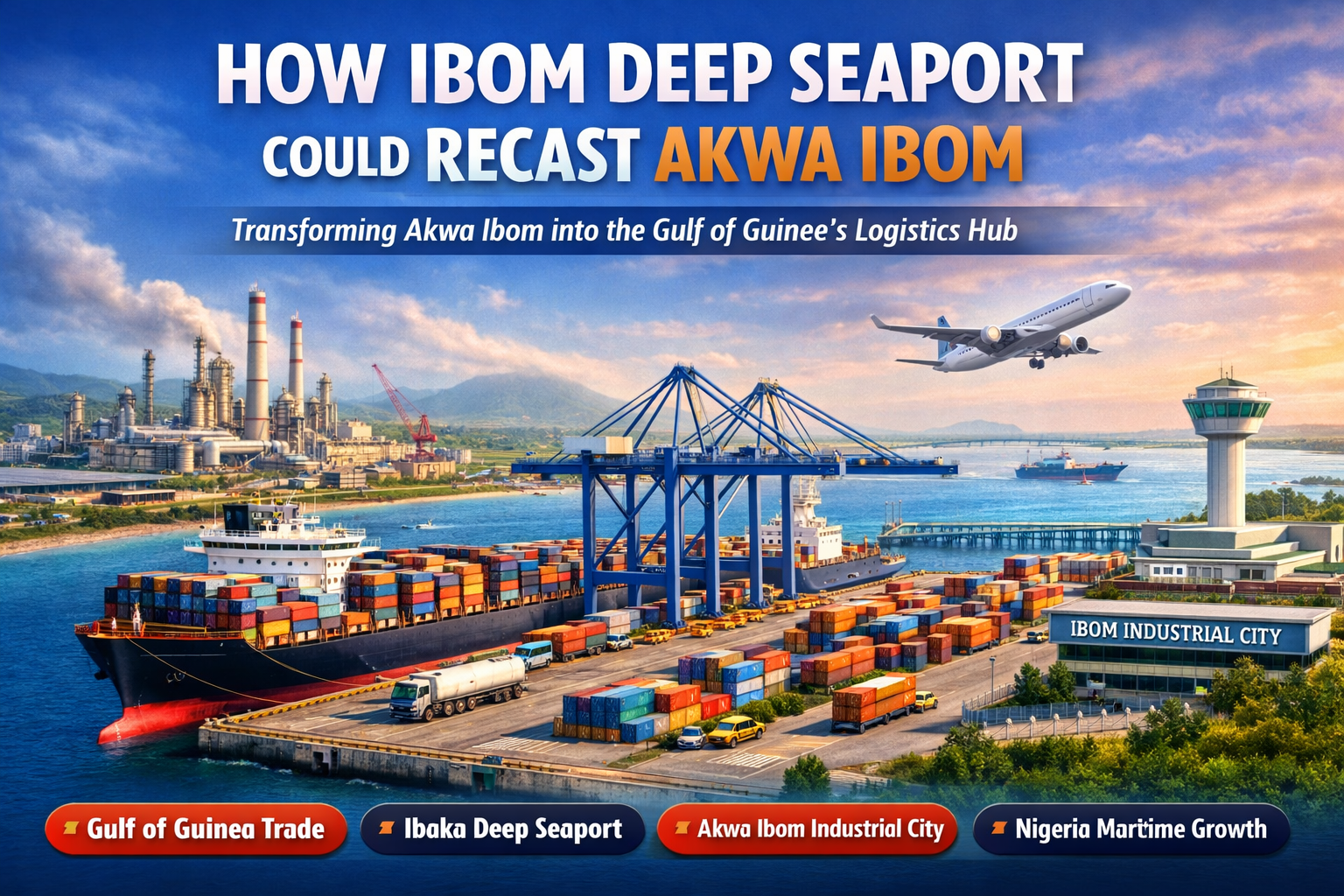
That question matters because the Ibom Deep Seaport is far more than a maritime project. It sits at the centre of a wider economic vision that seeks to reposition Akwa Ibom from a state known mainly for hydrocarbons and public sector spending into one driven by industry, exports and integrated logistics.
The project, as conceived, is expansive. Official materials and technical briefs describe a deep-water port complex at Ibaka capable of receiving very large container vessels and operating through multiple terminals over time. The long-term plan links the port to the proposed Ibom Industrial City and a free-trade ecosystem intended to support manufacturing, processing, warehousing and export-oriented business activity. Early projections have suggested a phased increase in container throughput from about 1.2 million TEUs in the initial stages to several million TEUs over the longer term, although public estimates vary.
The idea itself is not new. It dates back more than two decades to the administration of former Governor Obong Victor Attah. Since then, successive governments under Godswill Akpabio and Udom Emmanuel advanced aspects of the project through surveys, land acquisition and environmental approvals. What the present administration has done is to push the seaport higher up the federal agenda while placing it within a broader economic framework that includes aviation infrastructure, industrial land preparation and proposed energy investments such as the BUA refinery and gas-related projects.
That method reflects how major port infrastructure is usually delivered. Projects of this scale rarely emerge all at once. They advance through sequencing, land preparation, regulatory approvals, investor engagement and supporting infrastructure. In that sense, the Ibom Deep Seaport has moved beyond mere rhetoric, even if its most critical execution phases still lie ahead.
Its relevance to Nigeria is clear. For decades, the country’s cargo pressures have been concentrated around Lagos. Apapa and Tin Can Island remain major gateways, while Lekki Deep Sea Port has begun to reshape container traffic patterns. Yet congestion, urban limitations and weak hinterland connections continue to weigh on efficiency. A modern deep seaport in Akwa Ibom would not only help ease pressure on Lagos but also provide manufacturers and exporters in the South-South and South-East with a closer and potentially more efficient outlet to global markets.
That is where the geography becomes strategic. The Gulf of Guinea sits along important West African trade routes and wider international shipping lanes. Ports that can accommodate larger vessels, process cargo efficiently and connect seamlessly to industrial corridors tend to attract direct vessel calls, trans-shipment traffic and long-term private investment. This is the core economic logic behind the Ibom Deep Seaport. If it can offer deeper drafts, longer berths and integrated logistics, it could draw cargo flows that currently bypass much of Nigeria’s coastal potential.
Still, ambition must be tested against operational reality. Lekki has already shown how a well-designed deep seaport can alter cargo movement and attract bigger ships away from older terminals. Global examples such as Jebel Ali and Singapore show even more clearly what a successful deep-water hub can do when linked to free zones, industrial clusters and efficient transport systems. But those examples also make one fact unavoidable. A port succeeds only when roads, power, security, customs efficiency, storage systems and industrial demand all move in step.
That is why Akwa Ibom’s energy story is central to the seaport’s viability. The planned 200,000 barrel-per-day BUA refinery and petrochemical complex has the potential to provide substantial industrial demand and export volumes. A functioning seaport would give such a complex a practical outlet for refined products, petrochemicals and associated cargo. Governor Eno has consistently framed the port, refinery and industrial city as mutually reinforcing assets. In that vision, the state does not merely export raw resources. It processes, manufactures and ships higher-value goods through its own logistics corridor.
If that model takes hold, the impact could be significant. Port economies create jobs far beyond the quay. They drive demand for trucking, warehousing, marine services, customs brokerage, packaging, maintenance and light manufacturing. They also stimulate land development and private investment in adjoining areas. Yet the scale of those gains will depend on actual cargo throughput and on how quickly power, gas, water, roads and other industrial enablers come on stream.
This is where caution is justified. Economists and logistics specialists often make the same point. Ports are powerful enablers, but they are not automatic engines of growth. A new harbour without efficient operations, dependable transport links and credible industrial demand can become an underused asset. Nigeria’s history of infrastructure planning offers enough examples of projects whose potential was weakened by delays, weak coordination or incomplete supporting systems.
Security also matters. In the Gulf of Guinea, insurance costs, piracy concerns and perceptions of operational risk affect shipping decisions. Improvements in maritime security and efforts to reduce port dwell time will be important if Akwa Ibom wants to market itself as a predictable and commercially attractive destination for vessel operators and cargo owners.
Sceptics also raise another valid concern, the risk of overestimating demand. Nigeria has, at different times, entertained several deep-sea port ambitions. Without strong hinterland logistics and a solid industrial base, ports can end up competing for limited cargo volumes. Akwa Ibom may hold an advantage because of its energy assets, industrial ambitions and aviation infrastructure. Even so, that advantage will mean little without a clear financing structure, firm federal backing and fast progress on transport links to other parts of the country.
That is why the next stage is so important. The pathway is conceptually simple. Secure federal commitments. Finalise credible public-private partnership structures. Strengthen the regulatory framework for the free zone. Align port development with industrial and energy timelines. Build the road and logistics connections that allow cargo to move efficiently inland and back to the coast. The challenge, as always, lies in execution.
Governor Eno has repeatedly argued that the Ibom Deep Seaport would be an economic game changer not just for Akwa Ibom, but for the South-South, the South-East and Nigeria as a whole. That may well be true. But large claims must be matched by measurable progress. In the end, the success of the port will not be judged by announcements or public enthusiasm. It will be judged by berths completed, operators signed, vessels received, cargo handled and industries built around it.
If the pieces come together, Akwa Ibom could secure something rare in Nigeria’s economic history, a genuine chance to convert natural resource wealth into a diversified industrial base anchored by trade, logistics and value addition. That would give the state a stronger place in the Gulf of Guinea’s commercial map and reduce its dependence on the volatility of crude oil alone.
For now, the state has moved beyond abstract aspiration into the realm of approvals, land acquisition and structured advocacy. That is progress. But the real test begins here. The promise is substantial. The proof will be in the tonnage.
Ekaette Okon-Joseph is the Special Assistant on Media to Governor Umo Eno of Akwa Ibom State.