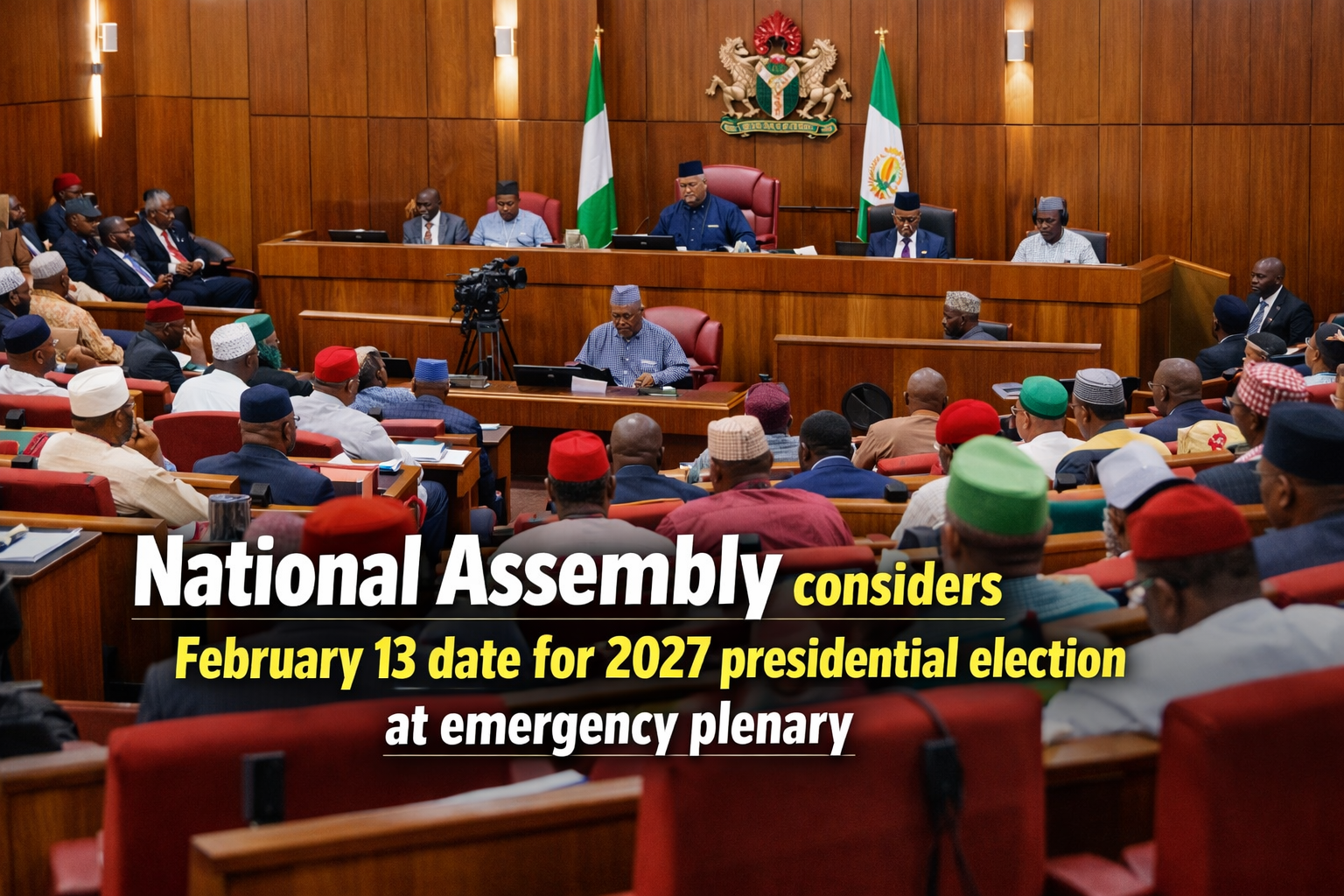

The National Assembly has summoned lawmakers back to Abuja for an emergency sitting, signalling a possible shift in the date of the 2027 presidential election.
A notice issued on Sunday directed senators and members of the House of Representatives to resume plenary on Tuesday February 17 2026 at 11 am, effectively ending the current recess. The directive, signed by the Clerk to the National Assembly Kamoru Ogunlana, cited the need to take decisions of high importance.
Parliamentary sources say the early recall is tied to plans to review the presidential election date already announced by the Independent National Electoral Commission. According to the sources, lawmakers are considering moving the poll to February 13 2027, one week earlier than the February 20 date earlier published by the commission.
A senior senator, who spoke on condition of anonymity, said the session was convened to give legal backing to a request from the electoral body. The lawmaker explained that the concern centres on the overlap between the proposed election date and the Ramadan fasting period.
Another source confirmed that discussions within the chambers point to a consensus around bringing the vote forward in order to remove religious and logistical obstacles to participation. The source said the decision would have implications for voter turnout and the perceived fairness of the process.
The move comes amid heightened scrutiny of electoral reforms at the National Assembly. Only days earlier, the Senate approved the use of electronic transfer of results to the commission Result Viewing Portal, while allowing manual collation in areas with connectivity challenges. The approval followed public pressure and protests triggered by contentious provisions in the Electoral Act amendment currently under consideration.
Under the revised framework, presiding officers are required to send results electronically once voting and documentation are concluded. Where this proves impossible, the paper result form will be used for collation and declaration.
During the debate, Senate President Godswill Akpabio urged members opposed to the changes to formally raise their objections on the floor, rather than outside the chamber.
Attention has now shifted to the election timetable itself. The Independent National Electoral Commission had earlier fixed February 20 2027 for the presidential and National Assembly elections, with state polls scheduled for March 6. Muslim groups and civil society organisations objected, arguing that the dates fall within Ramadan and could limit participation.
The concerns were echoed by political figures, including former presidential candidate Atiku Abubakar of the Peoples Democratic Party, who publicly called for a review. Former presidential aide Bashir Ahmad also appealed for a more inclusive timetable.
In response, the Independent National Electoral Commission acknowledged the objections and said it was consulting stakeholders. The commission stated that while the timetable complied with existing laws, it was open to legislative intervention if adjustments were required to protect participation and electoral integrity.
Meanwhile, a joint conference committee of both chambers is expected to meet to harmonise differences in the Electoral Act amendment bills passed separately by the Senate and the House. The committee has one week to resolve outstanding issues before forwarding a consolidated bill to President Bola Tinubu for assent.
Lawmakers have previously floated broader changes to the election calendar, including holding polls earlier to allow all legal disputes to be resolved before inauguration day in May 2027. Proposals have also included shorter timelines for election petitions and early voting for security personnel, election staff, journalists and observers.
The decision to reconvene plenary ahead of schedule reflects the growing political pressure surrounding the 2027 elections, as religious groups, opposition parties and civil society organisations intensify calls for a process that is widely seen as fair, inclusive and credible.