

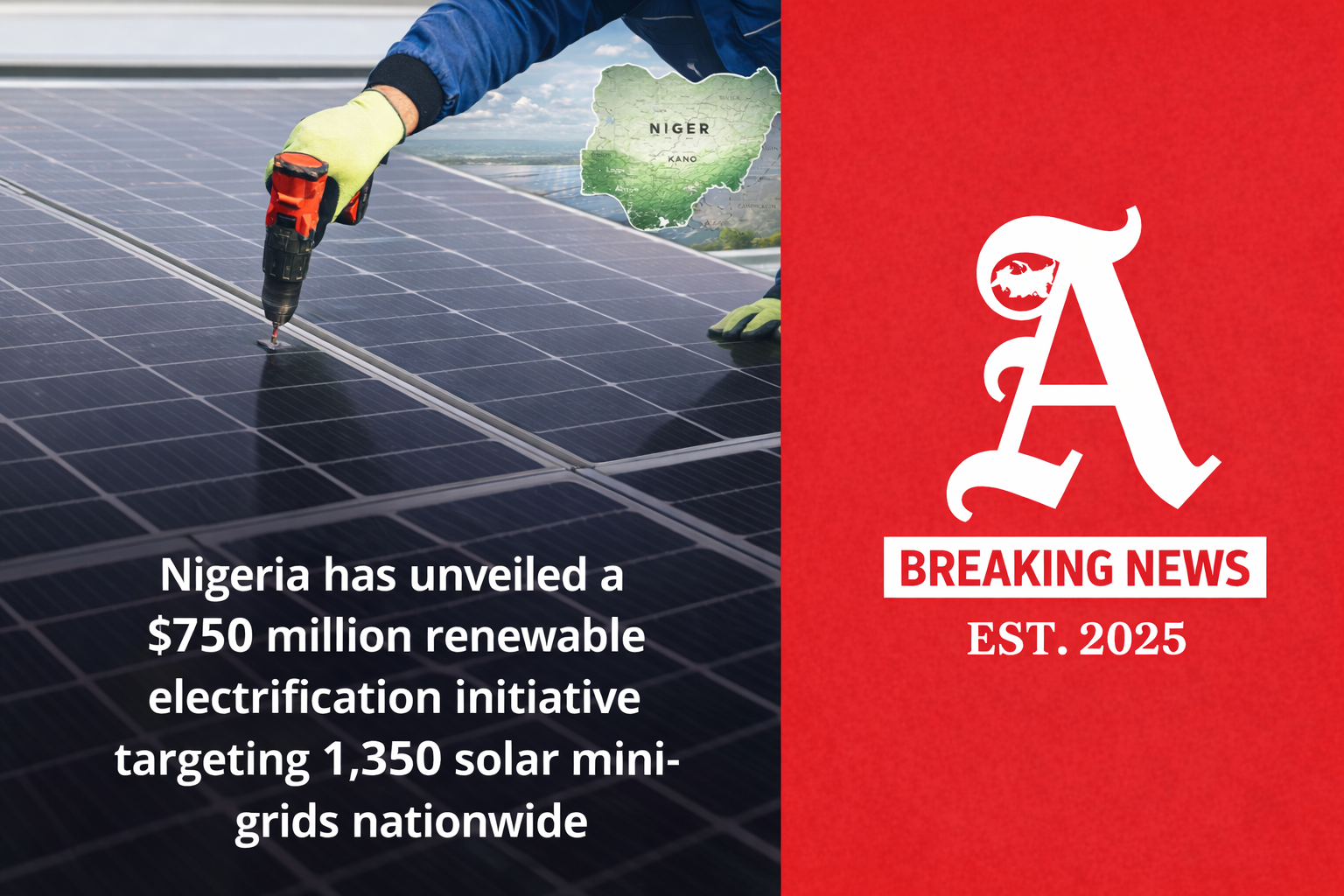


Nigeria has launched a 750 million dollar renewable electrification initiative aimed at widening electricity access across the country, with a major focus on rural communities and other underserved areas.
The programme will support the deployment of 1,350 solar mini grids nationwide, including 250 interconnected mini grids that will be linked to the national grid. Officials say the initiative is expected to attract about 1.1 billion dollars in private sector investment, while helping to deliver more reliable electricity to millions of Nigerians who still lack stable power supply.
The latest intervention reflects a broader effort by the Federal Government to use decentralised energy systems to close the country’s long standing electricity gap, especially in communities that remain beyond the reach of conventional grid infrastructure.
Beyond rural electrification, the government is also extending renewable energy projects to key public institutions. Through the Energising Education Programme, large scale solar projects are already supplying electricity to federal universities and teaching hospitals, helping to improve learning, research, healthcare delivery and general campus operations.
The initiative is expected to ease the power challenges faced by many tertiary institutions, where unstable electricity has often disrupted academic work, laboratory services and essential medical operations in teaching hospitals.
Government agencies and other public institutions are also benefiting from the National Public Sector Solarisation Initiative. The scheme is designed to reduce dependence on diesel generators, lower operating costs and provide cleaner, more stable electricity for public facilities.
For many institutions, the shift is expected to bring both financial and operational relief. High generator costs have remained a major burden on public offices and service delivery centres, especially in a period of rising energy prices.
Taken together, the mini grid rollout, university solar projects and public sector solarisation plan signal a stronger push by Nigeria to improve electricity access through renewable energy. The approach also points to a growing reliance on solar infrastructure as a practical response to weak grid supply and the rising cost of self generation.
If successfully implemented, the programme could mark a significant step in improving power access, supporting economic activity and reducing energy costs for communities and institutions across the country.