
By | YOUNG, D
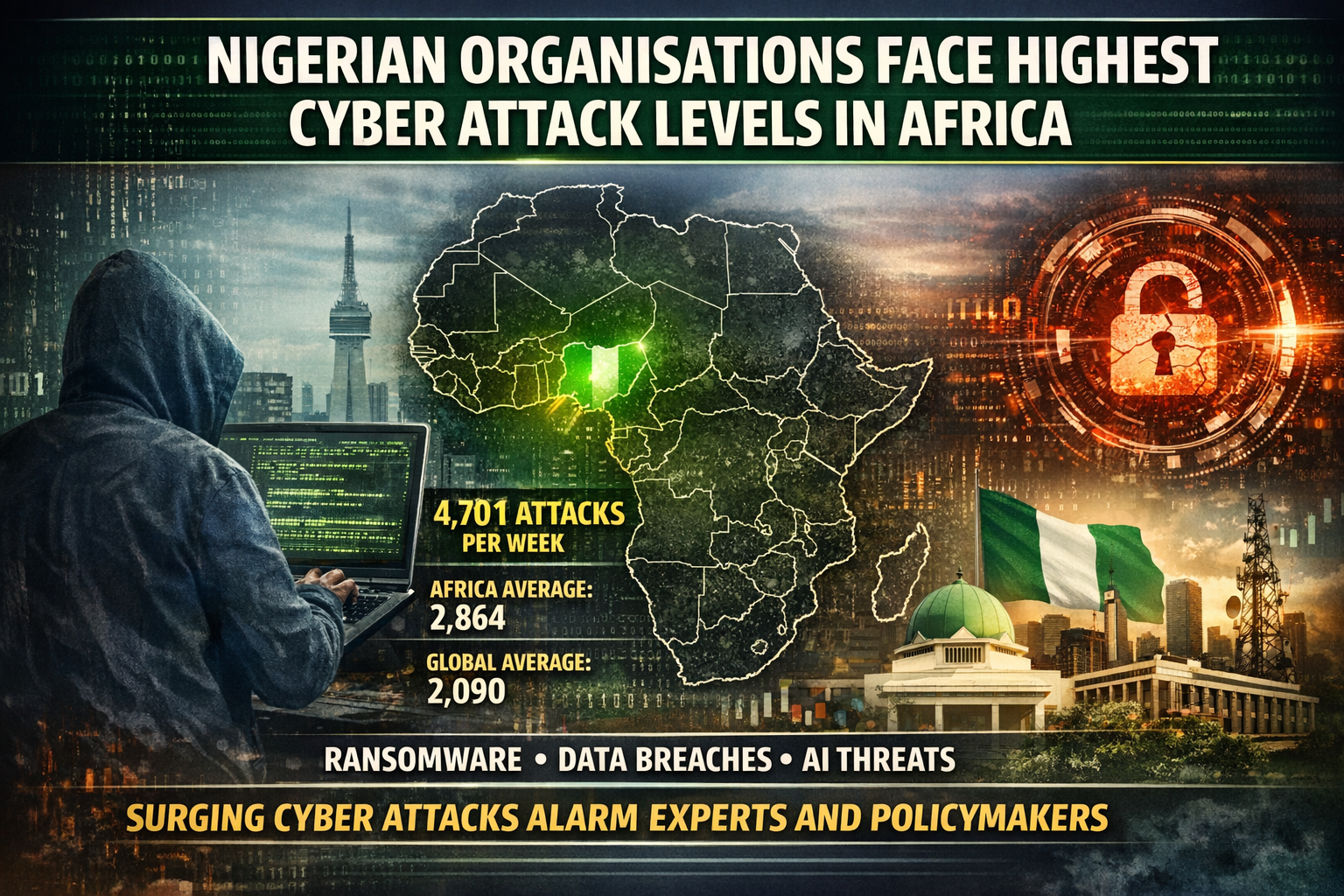
Nigerian organisations recorded the highest volume of cyber attacks in Africa in January 2026, with an average of 4,701 attacks per organisation every week, according to industry threat intelligence reports.
The figure places Nigeria well ahead of other African countries and far above both continental and global averages. Analysts say the data highlights the growing exposure of Nigerian institutions as digital adoption accelerates across critical sectors of the economy.
The January statistics show that organisations operating in Nigeria faced more attacks than the African average of about 2,864 incidents per organisation per week. The number also exceeded the global average of roughly 2,090 weekly attacks. Compared with December 2025, when Nigerian organisations recorded about 4,622 weekly attacks, the January figure reflects a continued upward trend.
Across Africa, Nigeria ranked first in reported attack frequency during the period. Angola followed with slightly lower figures, while South Africa and Kenya recorded substantially fewer weekly attacks per organisation. Security experts say the variation reflects differences in digital exposure, security maturity, and threat actor focus across national markets.
Researchers attribute Nigeria’s high ranking to several structural factors. Rapid growth in digital banking, telecommunications services, electronic commerce, and cloud based systems has expanded the country’s attack surface. Many organisations now operate complex digital environments that are difficult to monitor continuously, creating opportunities for automated and opportunistic attacks.
The growing use of generative artificial intelligence tools in workplaces has also emerged as a new source of risk. Analysts report that a significant share of employee interactions with such tools involve sensitive corporate or personal data. Where these tools are deployed without formal governance, attackers can exploit data leakage, phishing, and credential exposure.
Ransomware activity continued to drive global attack volumes in January, with automated attack tools enabling threat actors to target large numbers of organisations simultaneously. Nigerian organisations, particularly those with high transaction volumes and public facing services, were among the most exposed to these campaigns.
Financial services firms, government agencies, and telecommunications operators were identified as the most targeted sectors. These organisations manage large volumes of sensitive data and provide essential services, making them attractive targets for both financially motivated and disruptive attacks.
In response to the rising threat level, Nigerian authorities and industry stakeholders have been advancing stronger cyber security frameworks. These include proposals for minimum security standards, mandatory breach reporting, and improved information sharing between the public and private sectors.
Cyber security analysts warn that without sustained investment in monitoring, governance, and skills, attack volumes are likely to continue rising. They stress that traditional perimeter defences are no longer sufficient and that organisations must adopt continuous monitoring, stronger identity controls, and clearer oversight of cloud and artificial intelligence tools.
The January 2026 figures underline Nigeria’s position at the centre of Africa’s cyber threat landscape. Experts say the data should serve as a signal to business leaders and policy makers that cyber resilience must keep pace with digital transformation if economic stability and public trust are to be protected.
Destiny Young is a Technology and IT Infrastructure Management Executive and Cybersecurity Professional with extensive experience in enterprise systems, digital transformation, and cybersecurity management. He holds a First Class Master of Science degree in Digital Transformation, a Distinction grade Master of Business Administration with a specialisation in Cybersecurity, and a Master of Technology degree in Information Technology. His work focuses on strengthening cyber resilience in organisations and examining the relationship between technology, risk, and business strategy. Destiny is also an active academic researcher with a strong interest in cybersecurity governance and threat mitigation. He writes regularly on digital security issues affecting businesses in Nigeria and contributes to industry discussions on cyber risk management and policy development.