


…Bakassi, the oil wells dispute and the value of first-hand records
By | Nseabasi S. J. King
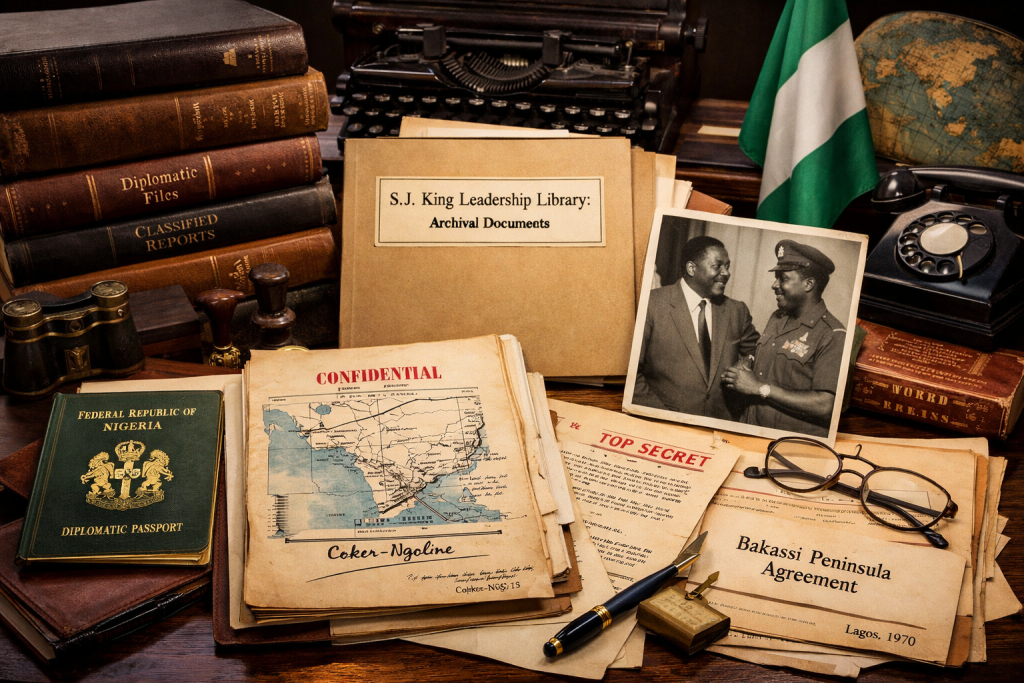
I am working with friends from around the world to establish a leadership library in Nigeria in honour of my late father, S. J. King.
S. J. King was a UK trained diplomat and the former Principal Private Secretary to the then Nigerian Head of State and Commander in Chief, General Yakubu Gowon.
As General Gowon’s principal staff and confidante at the time, he played active and significant roles in government and was privy to classified documents including sensitive security intelligence in the build up to the Nigerian Civil War.
Insider Weekly, a Nigerian investigative news magazine in an exclusive edition, Red Alert! Nigeria Under Threat, published on November 11, 2002, listed S. J. King among the top dignitaries in the high-powered Nigerian delegation that negotiated the Bakassi Peninsula with the Cameroonian government during the war.
“By this account, experts led by Chief R. Oluwole Coker, then Director of the Federal Survey Department in the Ministry of Works decided that the offshore delineation of the approach channel to the Calabar estuary should be about a 3-mile unit. It was Coker who actually decided the offshore border of the navigable channel in the peninsula. This formed the basis of what became known as the Coker-Ngoline. Accompanied by a delegation of top civil servants, from Cross River and Akwa Ibom states, Coker signed the declaration. The civil servants included one S. J. King who had previously served as Consul General in the Nigerian mission at Buea…” Insider Weekly, page 25, No. 45, November 11, 2002.
King’s private library is filled with personal notes and important documents on key and topical issues of government and international relations.
These are personal accounts of an elite with first-hand knowledge of what transpired in government business and decisions because he took part in those negotiations and contributed to the debates. His records are broad, dispassionate and devoid of the usual diplomatese of formal government accounts.
I am of the persuasion that there are such personal records of history tucked in or wasting away in elitist private libraries spread across the globe, with necessary accounts needed to enrich history and lend a wider narrative to issues.
I am proposing a shift from institutional history – which is often sanitized or redacted – to lived history, where the nuances of human decision-making are preserved in their purest form.
The proposed S. J. King Leadership Library in Nigeria would enhance learning and help students of history to better understand the factors and sentiments surrounding the circumstance that informed one decision of government or the other at any given time.
It is also worthy of mention, that the S. J. King Leadership Library is liberal in concept. In its framework, it is designed to accept and host invaluable materials from any other private libraries with verifiable documents in their archives.
History is often written by winners, but it is preserved by witnesses. Across the globe, some of the most critical accounts of 20th-century geopolitics are not found in national archives or public museums. Instead, they lie fallow – undisturbed and inaccessible, within the private libraries of retired diplomats, advisors, and high-level civil servants.
My approach seeks to change this, starting with the personal records of a man who stood at the intersection of African post-colonial stability and international diplomacy.
The coming on stream of the S. J. King Leadership Library would mean more unrestricted access to more invaluable knowledge that can correct misconceptions, heal wounds and open doors to long sought peace on issues of national interest and more.
As a Principal Private Secretary in Dodan Barracks, Lagos, and later as Cabinet Secretary in Government House, Calabar, or previously as Consul General in the Nigerian Mission, Buea, King sat in situation rooms where critical decisions that shaped the future and defined many generations were taken. The scribe in him took copious notes of people, events and places, and his records bear granular details of policy and decisions reached.
By transitioning these records from a private residence to a leadership library, we would be freeing up knowledge, allowing the next generation of African leaders to learn from the successes and regrets of their predecessors.
The Bakassi Peninsula remains one of the most complex geopolitical scars in West African history. While the 2002 International Court of Justice (ICJ) ruling was intended to provide a final legal resolution, it inadvertently triggered a domestic crisis that persists to this day: the 76 Oil Well Standoff between Cross River and Akwa Ibom States.
When the ICJ awarded the Bakassi Peninsula to Cameroon, the decision fundamentally altered Nigeria’s internal maritime boundaries.
The core of the current standoff lies in a 2012 Supreme Court of Nigeria ruling. The court held that by ceding Bakassi, Cross River State lost its status as a littoral (coastal) state.
Under Nigerian law, only littoral states are entitled to the 13% Derivation Fund from offshore oil production. Consequently, 76 oil wells formerly attributed to Cross River were reallocated to Akwa Ibom.
As of early 2026, the dispute has reached a fever pitch. The current Cross River State government argues that the Coker-Ngoline and other historical mappings prove that Cross River still possesses a navigable channel and maritime access. They argue that the loss of Bakassi should not equate to the total economic disenfranchisement of the state.
Relying on the 2012 and 2005 Supreme Court precedents, Akwa Ibom maintains that the boundaries are a settled law and that any reallocation would be unconstitutional.
The Revenue Mobilization Allocation and Fiscal Commission (RMAFC) is currently attempting to use new coordinate plotting to find a middle ground – a move that has sparked intense debate in both states.
In a room full of heated political rhetoric, the S. J. King Leadership Library can be the coolest voice – providing the data-driven clarity needed to move from emotion to evidence.
This is so, because official maps used in court rooms are often abstractions, while King was part of the delegation led by Chief R. Oluwole Coker that actually decided the offshore border.
The current standoff involves disputes over the 11th Edition Administrative Map of Nigeria. The truth is that government documents often hide the “give-and-take” of negotiations, but private libraries of this nature often hold early drafts of surveys and correspondence that never made it into the public archives.
The S. J. King Leadership Library can transform the Bakassi issue from a zero-sum game of oil revenue into a shared history lesson. If we unlock the fallow history of our fathers, we may find the keys to the peace of our children.
By understanding the human geography of the peninsula across these lines long before they were drawn -the library can suggest socio-cultural solutions that go beyond mere coordinates on a map.
As Nigeria grapples with the 2026 standoff between Cross River and Akwa Ibom over maritime oil revenues, a fundamental question arises: Why are we fighting over maps when the men who drew them left us the footnotes?
S. J. King in his public service years contributed in immeasurable ways to the fundamental development of political administration in Nigeria, and has many novelty to his credit. The Liaison Office administrative structure in Nigeria is his brain-child. He conceived, established and led the first ever State Liaison Office in Nigeria for the South Eastern State government in the then federal capital, Lagos. His motivation, the initial challenges and anxiety of the Federal Military Government then are all in black and white.
The library is so rich and has something for everyone to take away, including Bola Ahmed Tinubu, Nigeria’s current democratically elected president and former staff member of Mobil International, who may find it intriguing to know more on the historical perspective of his former employer and their early activities in Nigeria.
My father’s role and account of Nigeria’s oil politics, especially how he assisted Mobil Producing Nigeria to gain a foothold in the nation’s oil and gas industry are well documented and I have personally read them all.
In a letter dated 20 August, 1970, and addressed to Mr. E. L. Waggoner, Mobil Oil Corporation, International Division, New York, George F. Larsen wrote, “It is with great pleasure that by means of this letter I have the privilege of introducing to you Mr. S. J. King, the Permanent Secretary for the South Eastern State resident in Lagos. In this capacity Mr. King is directly responsible for representing the South Eastern State Governor, His Excellency, Colonel U. J. Esuene, in contacts with the Federal Military Government, Embassies and businessmen headquartered in Lagos.
“Before assuming his present position in December 1966(sic), Mr. King had various assignments in Nigeria’s Foreign Service and following a course in Diplomacy in Geneva he returned to Nigeria and served as Principal Private Secretary to the Head of State, General Gowon.
“I personally value Mr. King’s friendship and consider him to be a very good friend of Mobil. His sympathetic understanding of our problems and willingness to use his substantial influence on our behalf has contributed greatly in progressing the establishment of our operations in the South Eastern State.
“I am sure you will find it pleasant and worthwhile talking to Mr. King because of his warm personality, broad experience and current knowledge of matters considered important to both the South Eastern State and the Federal Government. Also I am confident that Mr. King will find the opportunity of talking to you equally rewarding.”
In a nutshell, the Mobil letter sums up the person and personality of my late father – the cerebral SJ with great depth and wealth of knowledge. Borrowing Mr. Larsen’s words, I am equally sure you will find it pleasant and worthwhile to partner with me and my friends to bring the S. J. King Leadership Library dream to fulfilment.
Nseabasi S. J. King
Founder, S. J. King Leadership Library
kingnseabasi@gmail.com