

MINDSCAPES SERIES SPECIAL EDITION: AKWA IBOM AND THE GOLDEN TORCH
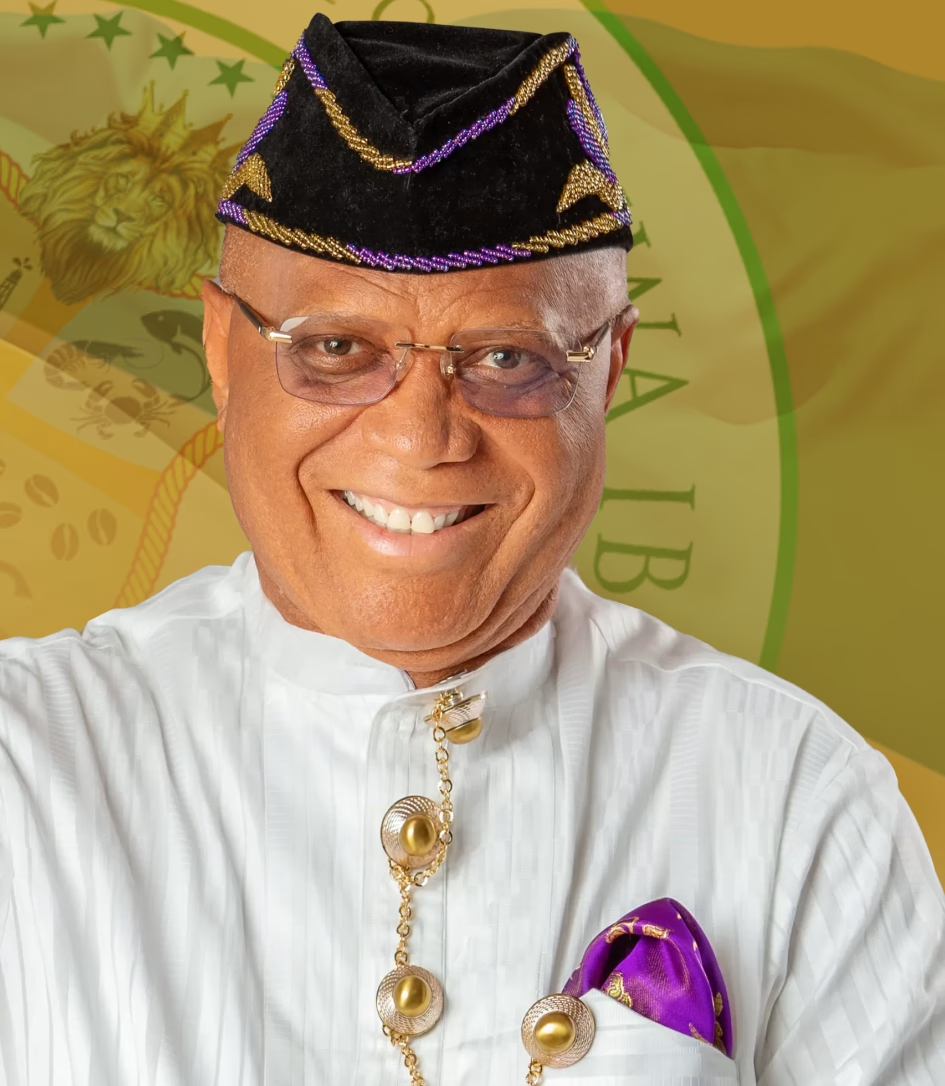
How Governor Umo Eno Is Passing Light from Soil to Sky
By Abom Ephraim Victor Okon, PhD, Esq.
Introduction: The Philosophy of Subnational Movement
Governance within the Nigerian subnational landscape has long suffered from a peculiar affliction: the persistent substitution of superficial motion for structural movement. Historically, administrations have measured their efficacy by the mere volume of public speeches, the frequency of ceremonial project flag-offs, and the thickness of policy blueprints bound in glossy covers. Yet across the federation, the gap between political intention and human outcome consistently widens, teaching citizens to evaluate their leaders not by what is declared in metropolitan centres, but by what remains fundamentally unchanged within their immediate daily existences. Akwa Ibom State, under the stewardship of Governor Umo Eno, is currently testing a radically different socio-political proposition: whether the mechanism of governance can return to its classical purpose—the methodical ordering of common communal life toward comprehensive human flourishing. Where the ancient Greeks defined this state of systemic well-being as eudaimonia, the deeply rooted cultural philosophy of the Ibibio captures it as idong ukot ikot—the intentional passing of a torch from house to house until the furthest corners of the village are illuminated.
What is unfolding across the state is not an overnight miracle, but a disciplined, replicable methodology that treats policy as philosophy in action, interprets critical infrastructure as the core skeleton of human dignity, and recognizes that the primary duty of leadership is to pass structural light from one life to the next without allowing the flame to die. In an age characterized by deep public cynicism, this quiet institutional focus is profoundly transformative. The imagery of the Golden Torch has transcended political metaphor to become the empirical metric of a subnational state learning to govern for the future rather than the next news cycle. Akwa Ibom State no longer relies on performative announcements; it demonstrates progress through tangible indicators: the quiet flare of airfield guidance systems at Victor Attah International Airport as an Airbus A220 aircraft taxis for a maiden flight to Accra; the home of a widow in Itu integrated into a sustainable rural electricity network; and a local smallholder farmer in Ikono who processes and weighs agricultural yields at Akwa Palm Limited and receives verified, non-custodial payment on the exact same day.
From Strategic Blueprint to an Operational State
When the ARISE Agenda was unveiled in 2023, it faced the familiar risk of becoming another decorative document relegated to ministerial shelves. Governor Umo Eno approached the governance of the state like an economic philosopher who had grown tired of abstract theory. He chose to analyze the systemic challenges of the state not through detached briefings compiled in Abuja, but through firsthand appraisals in the mud of Mkpat Enin rural corridors, within the quiet corridors of idle industrial factories, and in direct dialogue with vulnerable citizens who had long been minimized as mere data points in annual budgets. The administration instituted an uncompromising test for every proposed intervention: does this policy directly reach the individual who possesses no political lobbyist, no party affiliation card, and no direct access to the corridors of power in Uyo? If the answer was negative, the framework was immediately returned to the drawing board for structural reconfiguration.
By November 2025, this deliberate methodology yielded independently verifiable metrics. A socio-economic impact assessment presented at Government House in Uyo confirmed the generation of thirty thousand direct employment opportunities across the agricultural, tourism, construction, and services sectors. Concurrently, eight hundred thousand citizens were directly reached through target programmes spanning subsidized agricultural inputs to comprehensive health insurance schemes. Furthermore, more than ten billion naira in direct grants was transparently disbursed to smallholder farmers, market traders, and micro-enterprises without the suffocating bottlenecks historically associated with subnational bureaucracy. These milestones culminated in the Nigerian Governors’ Forum naming him the Governor of the Year for 2025, specifically citing Akwa Ibom State’s top-tier ranking in fiscal discipline, public transparency, and project delivery executed completely without recourse to external commercial borrowing. In a macroeconomic climate where subnational states routinely seek external loans simply to offset recurrent salary obligations, this fiscal self-reliance represents a major administrative triumph. It demonstrates the tangible yield of philosophy in motion—thinking clearly, executing deliberately, and measuring success solely by the expanding dignity of the populace.
Agriculture: Where Human Dignity Takes Root
The definitive test of any administration within Akwa Ibom State rests upon its concrete interventions for the agricultural producer. For generations, the rural narrative remained locked in a destructive cycle: produce, suffer post-harvest loss, incur predatory debt, and repeat. The introduction of the ARISE Home Farms initiative systematically altered this paradigm. Two thousand three hundred and twenty-three families received half a million naira grants to establish cultivation clusters around their immediate residential compounds, while forty thousand nine hundred farmers were furnished with certified inputs, modern processing machinery, and technical extension support through the Dakkada Warehouse and Training Centre. The true metric of this structural shift is captured in the changing realities of rural families, such as Madam Eno Effiong, a fifty-eight-year-old producer in Ikono, who noted that after twenty years of surrendering palm fruits to arbitrary buyers, she now processes her yields independently and sells directly to Akwa Palm Limited at guaranteed baseline rates, allowing her to secure her children’s educational future without predatory debt.
This institutional framework elevated regional crop production to 2.07 million tonnes and pushed aquaculture outputs to 2.76 million tonnes by the close of 2025. Local agricultural commodity markets across Uyo, Ikot Ekpene, and Eket registered the impact long before federal agencies documented the trend, as localized food supply stabilization insulated the state from the sharper edge of national food inflation spikes. Rather than stopping at primary production, the administration moved aggressively into vertical integration, fully reviving the long-dormant Akwa Palm Limited and operationalising the Ibom Paint Factory to convert local raw materials into high-grade industrial finished goods. These efforts are anchored financially by the Ibom Fadama Microfinance Bank, which allows rural co-operatives to access capital without surrendering ancestral land deeds. Locally celebrated as Idung idie ufok—the philosophy of eating from one’s own compound—this approach represents a return of sovereign dignity to the soil, transforming agriculture from a high-risk gamble into a highly deliberate act of economic independence.
Infrastructure and Aviation: Conduits of Trade and Sky Sovereignty
This structural expansion is mirrored within the state’s aviation sector. On May 2nd, 2026, Ibom Air flight 6Q 210 completed its maiden flight to Accra, Ghana, marking the formal activation of Victor Attah International Airport as a true regional hub. Rather than treating this asset as a political trophy, the administration funded the smart terminal architecture, West Africa’s leading Maintenance, Repair, and Overhaul facilities, and advanced night navigational lighting system lines. This infrastructure directly ties into the state’s natural gas architecture, reinforced by a landmark 3.5 billion dollar Final Investment Decision alongside the Nigerian National Petroleum Company to build multi-county pipelines and processing plants. By implementing local resource conversion, the state is transforming flared gas into commercial fertilizer, agricultural inputs, and sustainable industrial jobs.
Social Protection and the Electoral Horizon
Authentic governance requires the deliberate carrying of structural light into the most insulated corners of society. Through the ARISE Compassionate Homes initiative, two hundred and five detached residential houses have been delivered to verified widows, orphans, and vulnerable senior citizens based strictly on empirical socio-economic vulnerability matrices. Concurrently, the Bulk Purchase Agency supports four hundred and seventy-seven thousand households with subsidized food blankets, establishing a blueprint for cooperative federalism that federal administrators openly adopted as an operational data model for national cash transfer initiatives.
As preparations move into top gear for the upcoming electoral cycle, Governor Umo Eno approaches the political horizon from a position of undeniable institutional strength. Unlike the standard historical pattern of subnational incumbents rushing to flag off panic projects on the eve of elections, the Governor heads toward the polls with the vast majority of his fundamental governance promises completely fulfilled, his capital investments visibly working, and his systemic vision distinctly defined. The electorate is not being presented with a speculative gamble, but with an auditable, living record of administrative performance that shows the profound difference between political noise and sustainable institutional light.
Abom Ephraim Victor Okon, PhD, Esq., is the Special Assistant to the Governor of Akwa Ibom State on Grassroots Mobilisation. He writes from Okon, Essien Udim Local Government Area, May 2026.