


The Federal Government’s clearance of five proposed deep seaports for investment has placed Ibom Deep Seaport in Akwa Ibom State at the centre of Nigeria’s renewed maritime expansion plan.
The approval is part of a national effort to attract private investment, expand port capacity and strengthen Nigeria’s position as a leading maritime gateway in West and Central Africa.
The Managing Director of the Nigerian Ports Authority, Dr Abubakar Dantsoho, said the government had completed approvals, certifications and compliance processes for five deep seaport projects across the country.
The projects are Badagry Deep Sea Port in Lagos State, Olokola Deep Sea Port in Ondo State, Ibom Deep Sea Port in Akwa Ibom State, Bakassi Deep Sea Port in Cross River State and Bonny Deep Sea Port in Rivers State.
Dantsoho disclosed this in Lagos at the close of a three-day meeting of Managing Directors of Port Management Association of West and Central Africa, member ports and the Port Statisticians Network.
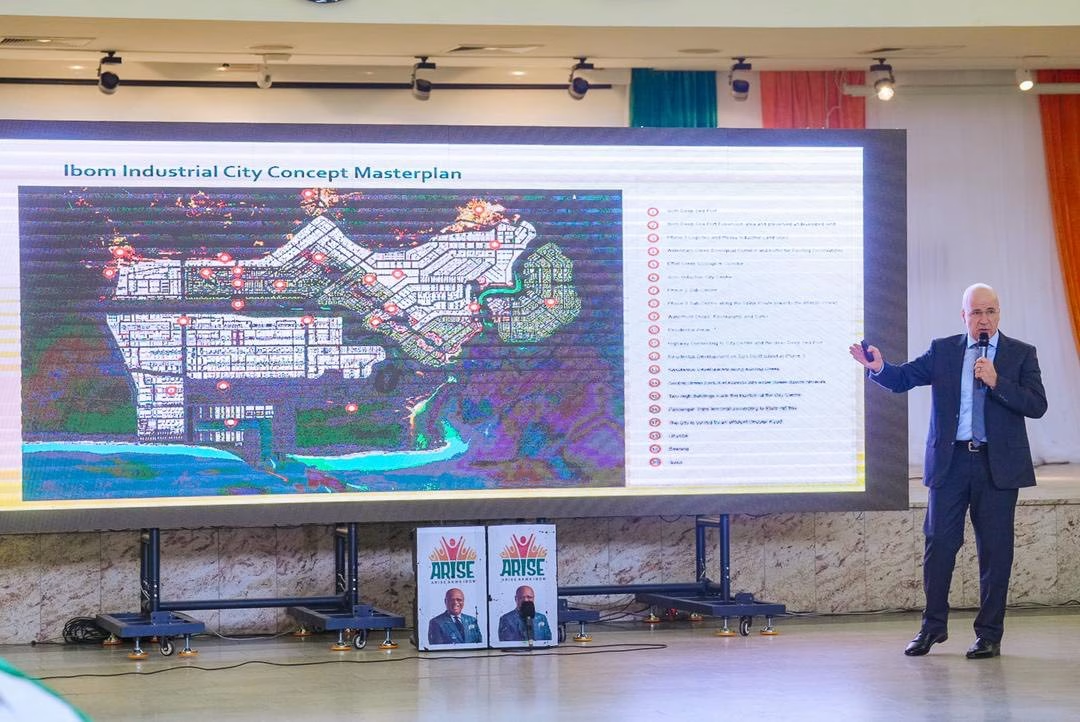
For Akwa Ibom, the inclusion of Ibom Deep Seaport among the cleared projects strengthens the state’s long-running ambition to become a major maritime, industrial and logistics hub in the Gulf of Guinea.
The project has been promoted as a strategic gateway for large vessels, export processing, industrial growth and regional trade.
Dantsoho said negotiations with investors were still ongoing because of the huge financial requirement of deep seaport projects. He, however, noted that the Federal Government had already laid the regulatory and administrative foundation required for implementation.
He said the new deep seaports would improve Nigeria’s capacity to receive larger cargo vessels, expand trade capacity and strengthen regional logistics.
According to him, Nigeria’s population, economic size and role in serving neighbouring landlocked countries make investment in deep seaports necessary.
Dantsoho also said Nigeria accounts for more than 70 per cent of cargo traffic within the West and Central African sub-region, while countries such as Niger, Chad, Mali and Burkina Faso depend partly on Nigerian ports for access to international trade.
The Ibom Deep Seaport project therefore fits into a wider national strategy to reduce pressure on existing ports, improve cargo evacuation and position Nigeria for stronger competition with other maritime economies in the sub-region.
The Federal Government is also pursuing short, medium and long-term reforms in the port sector. These include rehabilitation of existing ports, deployment of technology-driven systems and development of new deep-sea infrastructure.
At the regional level, Dantsoho said countries including Ghana, Senegal and Benin Republic are modernising their port facilities in response to rising global shipping demands and competition.
He said ports in West and Central Africa must modernise aggressively to remain competitive.
The meeting also resolved to deepen the deployment of technology-driven solutions, including the National Single Window platform and Port Community Systems, to improve cargo clearance and reduce delays.
The Minister of Marine and Blue Economy, Dr Adegboyega Oyetola, represented by the Director of Maritime Services in the ministry, Oyinloye Meshack, said the transformation of ports in West and Central Africa would require stronger cooperation, strategic investment and inclusive development.
He said the theme of the conference, “Ports of the Future: Combining Logistical Resilience with Inclusive Community Development,” reflected the need to build ports that are competitive, resilient and ready for future trade demands.
For Akwa Ibom, the clearance of Ibom Deep Seaport marks an important step in the state’s maritime development plan.
If matched with financing, investor commitment and coordinated infrastructure support, the project could expand the state’s role in shipping, logistics, industrial processing and regional trade.





It’s a welcome development, keep up the good work