

By | Destiny Young
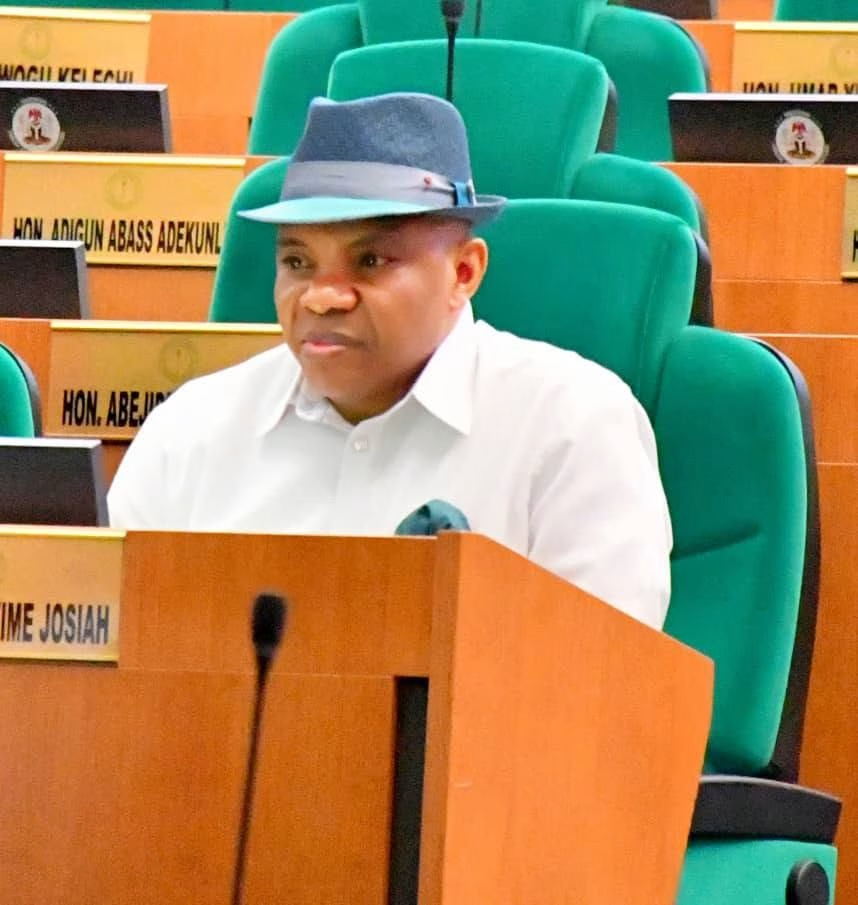
Political representation should produce measurable value. It should give the people a strong voice in government, attract development, expand access to education and create opportunities for citizens to improve their lives. By these standards, Rt. Hon. Unyime Josiah Idem has distinguished himself as one of Akwa Ibom State’s most productive federal lawmakers.
As an Akwa Ibom indigene and a keen observer of his human capital development programmes, I have followed his interventions with considerable interest. His record presents a politician who understands that leadership must extend beyond speeches, ceremonies and political mobilisation. It must address the practical needs of the people.
This is why I consider Rep. Unyime Idem a distinction grade legislator.
Since his election to represent the Ukanafun and Oruk Anam Federal Constituency in the House of Representatives in 2019, Idem has approached representation as a combination of lawmaking, oversight, constituency development and direct investment in people.
In the National Assembly, he has maintained an active legislative presence. His legislative interventions have focused on economic development, public accountability, infrastructure, telecommunications, education and the welfare of Nigerians.
His motion calling for the rehabilitation of the Nigerian Institute for Oil Palm Research substation in Oruk Anam demonstrated his understanding of the economic history and agricultural potential of his constituency. Restoring such an institution could support research, employment, food production and the revitalisation of the palm oil economy.
He has also drawn national attention to the need for improved consumer protection in the satellite television industry, better infrastructure and stronger public procurement systems.
As Chairman of the House Committee on Public Procurement, Rep. Idem occupies a position that is central to public accountability. Public procurement determines how government contracts are awarded, how public funds are spent and whether citizens receive value from government projects. His role places on him the responsibility of promoting compliance, transparency and fiscal discipline across public institutions.
However, what gives his representation a special character is his sustained commitment to human capital development.
Rep. Idem understands a basic principle of development. Roads, buildings and electricity projects are necessary, but people must also possess the education, technical competence and economic capacity to use those facilities productively.
This thinking is visible in the scale and diversity of his empowerment programmes.
Thousands of constituents have participated in skills acquisition, capacity building and economic empowerment initiatives supported by him. Beneficiaries have received training in digital job creation, entrepreneurship, vocational skills and other areas capable of supporting employment and self reliance.
Some young people have also participated in specialised training outside Nigeria, including programmes in China, Rwanda and the United Kingdom. These opportunities expose beneficiaries to new technologies, professional standards and international development practices.
His digital job creation programmes deserve particular recognition. At a time when technology is changing employment patterns, equipping young people with digital skills is more sustainable than providing temporary financial relief. Digital competence can connect a young person in Ukanafun or Oruk Anam to employment, entrepreneurship and markets beyond Akwa Ibom State.
His approach to empowerment has also included grants, working equipment, vehicles, motorcycles, sewing machines and other forms of productive support. These interventions help beneficiaries establish or strengthen small businesses, create income and support their families.
His physical projects complement these investments in people. His interventions include classroom blocks, information and communication technology centres, administrative buildings, roads, drainage facilities, streetlights and electricity infrastructure.
Schools within the federal constituency have benefited from books, instructional materials and improvements to learning facilities. Classroom blocks and ICT centres have also been provided in educational institutions within and outside the immediate constituency.
These are important investments because the quality of education depends partly on the environment in which teaching and learning take place. A child who has access to a safe classroom, books, electricity and digital facilities has a stronger foundation for academic development.
Rep. Idem’s latest educational intervention further strengthens his reputation as a legislator who places knowledge at the centre of development.
Earlier in 2026, he announced a comprehensive scholarship programme for 200 undergraduate, master’s and doctoral students from Ukanafun and Oruk Anam studying in Nigerian federal universities. The scholarship package was designed to cover tuition, accommodation and living expenses for successful beneficiaries in selected disciplines.
He has now expanded his educational support through a partnership with Southern Atlantic University, Uyo, where he is facilitating a full undergraduate degree scholarship for interested and qualified indigenes of Akwa Ibom State.
This intervention is significant for several reasons.
It extends the opportunity beyond his immediate federal constituency to eligible Akwa Ibom people. It creates another route into university education for young people whose ambitions may be limited by financial difficulties. It also supports a university located within the state, contributing to the growth of Akwa Ibom as an emerging centre for education, innovation and entrepreneurship.
Prospective beneficiaries with the required qualifications will have an opportunity to pursue undergraduate programmes at Southern Atlantic University. The institution offers programmes in areas such as cybersecurity, computer science, software engineering, accounting, business administration, political science, international relations, microbiology, public administration, hospitality and tourism management.
His relationship with the university also includes a pledge to support the institution with a classroom block and a financial contribution. This shows that his interest goes beyond sponsoring individual students. He is also contributing to the institutional capacity required to provide quality education.
For me, this is what responsible political leadership should represent.
A scholarship does more than pay school fees. It can change the direction of an entire family. When a young person receives quality education, acquires professional competence and becomes economically productive, the benefit extends to parents, siblings, communities and future generations.
Education remains one of the most reliable tools for reducing poverty, expanding opportunity and building a stable society. A politician who invests consistently in education is making an investment whose impact may continue long after the end of his tenure.
Rep. Unyime Idem has also demonstrated that effective representation requires accessibility. Through his empowerment centre and constituency structures, citizens have a recognisable point of contact for programmes, applications and interventions. This gives practical meaning to the relationship between an elected representative and the people.
His recognition by several organisations as an outstanding legislator did not emerge from political slogans alone. It reflects a record of legislative activity, constituency projects, education support, skills development and economic empowerment.
No public official is beyond scrutiny, and every political leader must remain accountable to the people. Commendation should never replace objective assessment. However, fairness also requires society to recognise leaders who demonstrate initiative, productivity and a commitment to human development.
Akwa Ibom State needs politicians who see leadership as a platform for building people. We need representatives who can participate effectively in national lawmaking while remaining connected to the development needs of their communities.
We need politicians who understand technology, education, enterprise and the changing nature of work. We need leaders who provide immediate support without neglecting long term development. We need representatives who measure success through the number of people given the capacity to succeed.
Rep. Unyime Idem represents many of these qualities.
His programmes show that political power can create classrooms, support businesses, develop digital skills, provide scholarships and expose young people to opportunities within and outside Nigeria.
Such leadership deserves recognition. It also deserves sustained support so that existing programmes can be strengthened, expanded and institutionalised.
Akwa Ibom needs more political leaders who invest in human beings with the same seriousness given to physical infrastructure. The future of our state will depend on the education, competence, productivity and innovative capacity of our people.
For his legislative contributions, constituency development projects and sustained investment in education and human capital, Rep. Unyime Idem has earned his place as a distinction grade legislator.
Supporting such a politician should not depend solely on party affiliation or temporary political calculations. It should be based on performance, accessibility and measurable contributions to society.
When a leader consistently creates opportunities for people to learn, work and prosper, supporting that leader becomes an investment in the advancement of humanity.