

By | YOUNG, D
The Equinix data centre that recently opened in Port Harcourt is more than a new colocation facility. It is a quiet reordering of Nigeria’s digital geography, a signal that the age of Lagos‑monopolised connectivity is starting to give way to a more distributed architecture. Yet, even as the industry celebrates this South‑South pivot, a strategic opportunity still looms large in Akwa Ibom State, where the 2Africa subsea cable makes land at Qua Iboe Beach. That opportunity is the deliberate creation of a state‑anchored data‑centre cluster at the geographic epicentre of Nigeria’s newest international gateway.

This article argues that Akwa Ibom is uniquely positioned to host the next major node in Nigeria’s data‑centre network, and that doing so would significantly reduce the country’s dependence on a single‑point‑of‑failure model that has repeatedly cost businesses, banks and ordinary Nigerians when undersea cables or transit corridors fail.
Lagos as a single‑point‑of‑failure for Nigerian connectivity
For decades, Nigeria’s digital economy has functioned as if its lifeblood runs through a single artery. Almost all of the nation’s major subsea cables land along a narrow coastal strip in Lagos. MainOne, ACE, SAT‑3, WACS, Glo‑1 and their successors have clustered at Victoria Island and nearby landing areas, bundling international bandwidth into a concentrated coastal hub.
To understand what a single‑point‑of‑failure means in practical terms, consider this scenario. Imagine a bank in Port Harcourt that relies entirely on an internet link routed through a single data‑centre in Lagos. All online transactions, mobile banking requests and ATM authorisations depend on that one facility and the one fibre path feeding it. If a fire, power blackout or major cable fault occurs at that Lagos data‑centre or along that specific route, every system connected to it can go offline at once. The bank may suddenly lose access to core systems, online banking platforms may freeze and customers in multiple states may be unable to perform any transactions, even though the problem is confined to one physical location. That is the essence of a single‑point‑of‑failure: when multiple dependent systems collapse because one critical element fails, turning what should be a local incident into a nationwide disruption.
When an underwater landslide off Côte d’Ivoire in March 2024 severed multiple cables, including ACE, MainOne, SAT‑3 and WACS, the impact rippled across Nigeria. Online transactions dropped, businesses lost hours of uptime and users in far‑flung states suddenly confronted what it means when the nation’s digital spine breaks at one point. That episode underlined the reality that an architecture reliant on one landing zone, one right‑of‑way corridor or one major colocation campus will inevitably suffer national‑scale shocks when that node is compromised.
The Lagos‑centric layout has been efficient, but it has also been fragile. Equinix’s Midletham II colocation facility in Lagos is already operating near full capacity, and many national and multinational organisations effectively tunnel everything through that single hub. This creates predictable congestion, elevated latency and a political‑economic imbalance in which almost all value is captured in one coastal city, while the rest of the country endures second‑class digital performance.
Equinix’s South‑South pivot and its implications
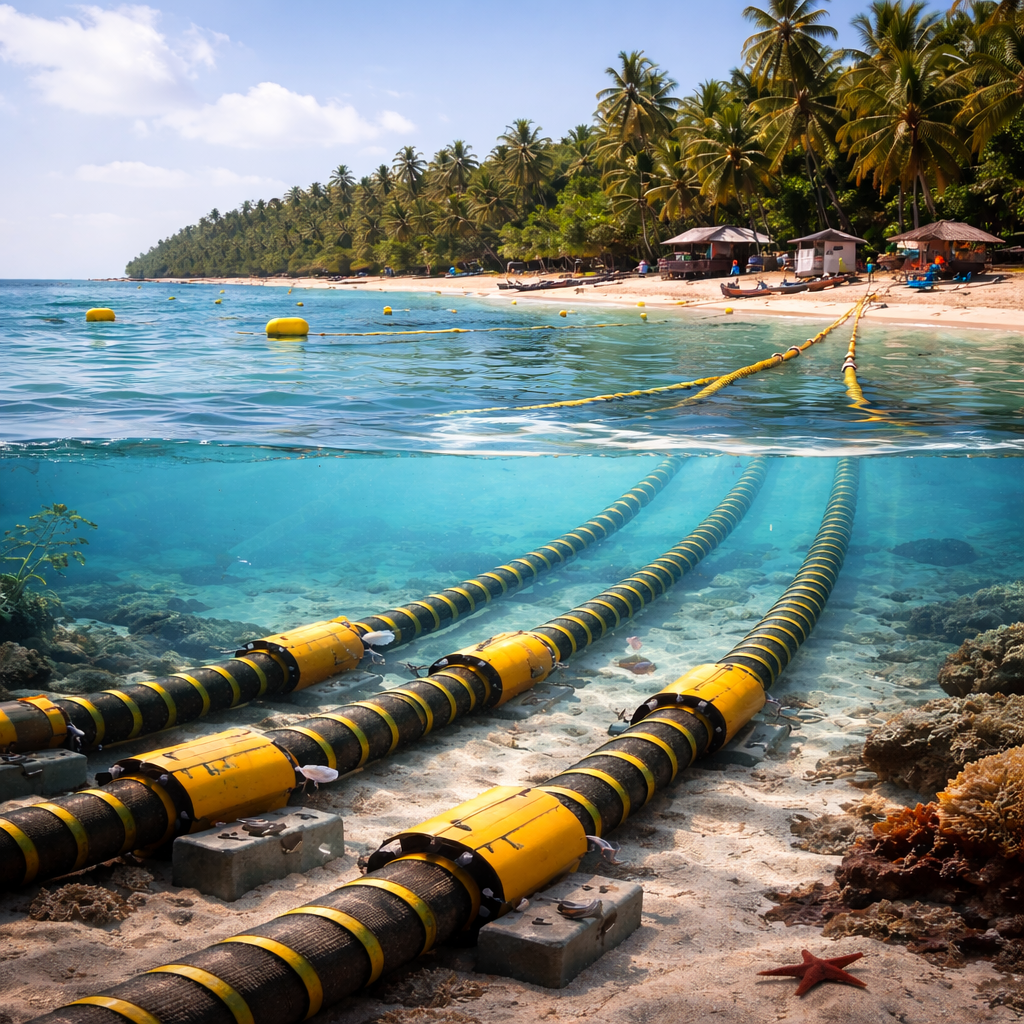
Enter Equinix and its new South‑South footprint. The company has erected a modular cable‑landing station at Qua Iboe Beach in Akwa Ibom State, where its 2Africa cable reaches the Nigerian coastline. From that landing point, roughly 250 kilometres of new terrestrial fibre extend across multiple states into Port Harcourt, effectively creating a secondary backbone. At the end of that backbone sits PR1, a carrier‑neutral data‑centre campus that is already hosting infrastructure from at least one global technology firm.
On paper, this architecture starts to dilute the single‑point‑of‑failure problem. Instead of all international bandwidth funneling through Lagos, a substantial volume of traffic can now terminate in the South‑South, be processed regionally and only then be backbone linkages. This reduces the load on Lagos‑centric facilities, offers a reroute option in the event of outages and cuts latency for users in the Niger Delta, South‑East and beyond.
What is less obvious but equally important is that this move reframes Port Harcourt from an economic backwater to a legitimate connectivity node on the national map. For the first time, enterprises and service providers can consider colocating or peering in the South‑South without forcing all traffic to first loop back through Lagos. Banks, fintech platforms and industrial operators in Rivers, Akwa Ibom and neighbouring states can now place key components of their infrastructure closer to the communities they serve, rather than relying on long‑haul, Lagos‑centric routing.
Even so, a conceptual gap remains. The physical cable lands in Akwa Ibom, yet the flagship data‑centre node sits in Port Harcourt. Between the two lies hundreds of kilometres of terrestrial fibre, each segment a potential point of failure or delay. This design is logical for political, commercial and security reasons, but it also means Nigeria has not yet built its most strategically coherent architecture at the cable‑landing point.
That is where Akwa Ibom State enters the picture.
Why Akwa Ibom should anchor its own data‑centre ecosystem
Akwa Ibom offers a rare combination of attributes that make it a natural home for a modern data‑centre ecosystem. First, it has become Nigeria’s premier subsea‑cable landing site outside Lagos. The 2Africa landing at Qua Iboe Beach places the state directly at the point where international optical fibre first touches Nigerian soil. Second, Akwa Ibom is already working to position itself as a business‑enabling jurisdiction, with initiatives such as a Business Enabling Reform Action Plan that specifically targets the attraction of technology and infrastructure investors.
A deliberate policy of anchoring one or more Tier‑II or Tier‑III grade data centres at or near Qua Iboe would shorten the path from seabed to server. Instead of forcing every workload from Akwa Ibom, Cross River, Rivers, Bayelsa and much of the South‑East to first ride long‑haul fibre to Port Harcourt or Lagos, local traffic could be processed within the state. Hyperscalers, financial institutions and government agencies could deploy edge or regional nodes precisely at the international gateway, dramatically shortening latency while reducing backhaul exposure.
Moreover, Akwa Ibom sits at the heart of a densely populated territory. Rivers, Akwa Ibom, Bayelsa, Cross River and parts of the South‑East account for tens of millions of Nigerians whose digital experiences today are shaped by Lagos‑centric routing. Bringing data‑centre capacity closer to this demographic and economic mass would transform the reliability of online education, telemedicine, e‑commerce and digital financial‑services for an entire hinterland.
Resilience is another compelling reason. By co‑locating data‑centre infrastructure near multiple landing points and diverse terrestrial corridors, Nigeria can engineer systems that do not collapse when one route is severed. Akwa Ibom can thus act as a “second spine”, supplementing Lagos rather than displacing it, but clearly reducing dependence on a single geography.
Beyond cables: single‑point‑of‑failure in transit and governance
The single‑point‑of‑failure concept does not apply only to cables or landing sites. It also applies to transit paths and to the fragmented governance of digital infrastructure. Nigeria currently has multiple cables, multiple ISPs and multiple data‑centre campuses. But many of these converge along a small set of high‑value corridors. If fibre routes to Lagos, Kaduna, Abuja and Port Harcourt are themselves under‑protected and operationally dependent on limited rights‑of‑way, a single excavation incident, environmental hazard or regulatory bottleneck can effectively recreate the same cascading failure, even if the cables themselves remain intact.
Akwa Ibom has a chance to be part of the solution. A well‑planned data‑centre and submarine‑cable cluster backed by streamlined permits, enforceable protection laws and a state‑level “digital gateway” zoning policy would begin to reframe underwater cables and their terrestrial extensions as critical national infrastructure. This does not mean shielding them from routine maintenance or competition, but it does mean that any damage or disruption to those assets would be treated as a core economic‑security issue rather than a mere infrastructure incident.
Akwa Ibom can and should, therefore, push for federal recognition of its landing point as a second “national gateway”, on par with Lagos in strategic importance. Recognition should be matched with practical enablers, including power‑capacity allocation, security protocols and coordinated emergency‑response planning across maritime, telecommunications and state‑security agencies.
A concrete call to action for Akwa Ibom
The Equinix South‑South initiative is an important milestone, but it should not be the final word in Nigeria’s data‑centre strategy. Akwa Ibom State, precisely because it is where the 2Africa cable first meets Nigerian soil, has a historic window to position itself as the anchor of the country’s next great digital node.
Three clear actions are warranted.
First, Akwa Ibom should designate Qua Iboe or an adjacent location as a licensed “Digital Gateway Zone”, with predictable planning rules, fast‑tracked environmental and construction permits and dedicated security and maintenance protocols for submarine and terrestrial fibre as well as adjacent data‑centre campuses. This zone should be marketed not only as landing infrastructure, but as a complete digital‑economy ecosystem.
Second, the state government should partner with Equinix, MTN, Globacom and other infrastructure providers to encourage the siting of at least one major Tier‑II or Tier‑III data‑centre within the state, close to the cable landing. This would give enterprises, public‑sector agencies and regional startups the option to colocate or connect at the precise point of international ingress rather than after multiple hops over congestible paths.
Third, federal authorities, including the Nigerian Communications Commission and the Ministry of Communications, Innovation and Digital Economy, should formally re‑engineer Nigeria’s conceptual network by recognising Lagos and Akwa Ibom as dual anchor points for international connectivity. This would reinforce investments in Akwa Ibom, encourage further diversification of landing‑point locations and help shift Nigeria from a high‑risk single‑point‑of‑failure architecture to one that is genuinely multi‑homed and resilient.
Conclusion: Akwa Ibom as the next pivot in Nigeria’s digital spine
The opening of Equinix’s Port Harcourt data centre is a welcome signal that Nigeria’s connectivity is starting to decentralise. Yet, as long as the subsea cable lands in Akwa Ibom but the flagship data‑centre node sits down the road in Rivers State, the nation will remain partially locked into a lopsided, risk‑prone model.
Akwa Ibom has a choice. It can accept the status quo, where the state hosts the physical entry point for one of the world’s longest subsea cables but lets most of the economic and infrastructural upside flow elsewhere. Or it can act deliberately to build its own data‑centre cluster, right at Qua Iboe, and anchor a more resilient, geographically balanced, lower‑latency digital backbone for Nigeria.
For the sake of Lagos‑centric single‑point‑of‑failure risk reduction, for regional economic equity and for a more credible national‑digital profile, Akwa Ibom should step into that role. The cable has landed. The question now is whether Akwa Ibom will build the data‑centre future that its geography commands.
About the author:
Destiny Young is a Technology and IT Infrastructure Management Executive and Cybersecurity Professional with extensive experience in enterprise systems, digital transformation, and cybersecurity management.