



By | YOUNG, D
Abuja. The National Assembly of Nigeria on Tuesday passed the Amended Electoral Act 2026 into law, repealing and modifying selected provisions of the Electoral Act 2022. The legislation was approved by both chambers after harmonisation of amendments and is intended to govern the conduct of the 2027 general elections.
The bill now awaits presidential assent by Bola Tinubu. Lawmakers described the amendments as corrective, arguing that they address operational challenges observed during the 2023 elections while retaining the core framework introduced in 2022.
The Electoral Act 2022 was widely regarded as a milestone. It strengthened the legal basis for technology driven elections, extended timelines for electoral activities, and enhanced the autonomy of the Independent National Electoral Commission. The 2026 amendment does not repeal these foundations. Instead, it introduces targeted revisions in key areas.
KEY CHANGES INTRODUCED BY THE AMENDED ELECTORAL ACT 2026
Election notice period
Under the 2022 law, INEC was required to publish notice of general elections at least 360 days before polling day. The amended act reduces this period to 300 days. Lawmakers said the change provides greater scheduling flexibility and reduces prolonged campaign seasons, while still giving parties and voters sufficient preparation time.
Transmission of election results
The 2022 act permitted electronic transmission of results subject to INEC guidelines. It did not expressly mandate real time transmission from polling units. The 2026 amendment clarifies this framework. Results are to be electronically transmitted after completion and certification of polling unit result forms. Manual collation remains valid where technical limitations occur. This provision represents a compromise between full digital transmission and operational realities in areas with poor connectivity.
Voter identification requirements
Proposals to replace the Permanent Voter Card with alternative identity documents were debated during the amendment process. The final law retains the Permanent Voter Card as the primary instrument for voter identification. Accreditation continues to rely on INEC approved technology, including biometric verification.
Political party primaries
The 2022 act imposed stricter timelines and reporting requirements for party primaries. The amended act retains these timelines but clarifies that political parties may choose their preferred mode of primaries in line with their constitutions, provided they comply with statutory notice and monitoring requirements.
Electoral offences and penalties
The new law adjusts penalties for selected electoral offences. While offences such as vote buying, voter card trading, and election interference remain criminal, fines and custodial sentences have been reviewed upward in some cases to strengthen deterrence.
Legal certainty and dispute management
The amendment introduces clearer drafting in sections relating to election procedures and compliance thresholds. Lawmakers said this is intended to reduce post election litigation arising from ambiguous statutory language.
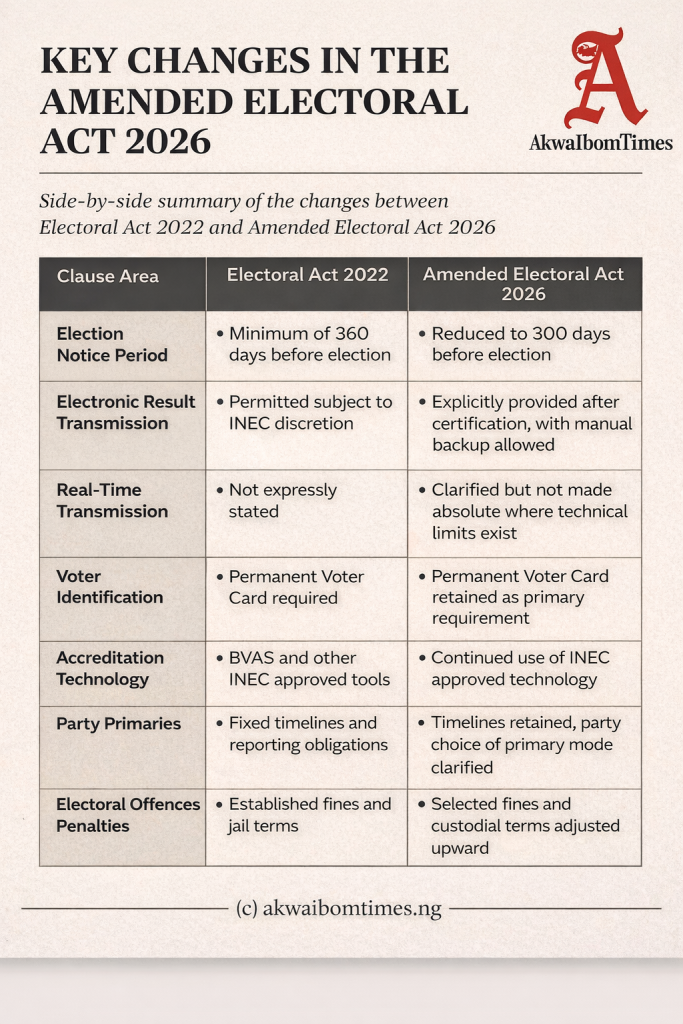
SIDE BY SIDE SUMMARY OF CHANGES BETWEEN ELECTORAL ACT 2022 AND AMENDED ELECTORAL ACT 2026
| Clause Area | Electoral Act 2022 | Amended Electoral Act 2026 |
| Election notice period | Minimum of 360 days before election | Reduced to 300 days before election |
| Electronic result transmission | Permitted subject to INEC discretion | Explicitly provided after certification, with manual backup allowed |
| Real time transmission | Not expressly stated | Clarified but not absolute where technical limits exist |
| Voter identification | Permanent Voter Card required | Permanent Voter Card retained as primary requirement |
| Accreditation technology | BVAS and other INEC approved tools | Continued use of INEC approved technology |
| Party primaries | Fixed timelines and reporting obligations | Timelines retained, party choice of primary mode clarified |
| Electoral offences penalties | Established fines and custodial sentences | Selected fines and custodial sentences adjusted upward |
| Drafting clarity | Some broadly worded provisions | Clarified language to reduce procedural disputes |
IMPLICATIONS FOR THE 2027 GENERAL ELECTIONS
The Amended Electoral Act 2026 sets the legal framework for the 2027 elections. Supporters argue that it balances innovation with practicality and reduces uncertainty for election managers and political parties. Critics remain concerned that flexibility in results transmission could affect public confidence if not transparently implemented.
As preparations for the next election cycle begin, attention is expected to shift from the text of the law to its enforcement. How INEC applies the amended provisions will largely determine whether the reforms strengthen or weaken electoral credibility.
Destiny Young is a Technology and IT Infrastructure Management Executive and Cybersecurity Professional with extensive experience in enterprise systems, digital transformation, and cybersecurity management. He holds a First Class Master of Science degree in Digital Transformation, a Distinction grade Master of Business Administration with a specialisation in Cybersecurity, and a Master of Technology degree in Information Technology. His work focuses on strengthening cyber resilience in organisations and examining the relationship between technology, risk, and business strategy. Destiny is also an active academic researcher with a strong interest in cybersecurity governance and threat mitigation. He writes regularly on digital security issues affecting businesses in Nigeria and contributes to industry discussions on cyber risk management and policy development.