


By | Destiny Young
In Nigeria’s digital economy, the mobile phone number is no longer just a contact detail. It has become a key identity tool. Banks use it for alerts and account recovery. Fintechs use it for onboarding and authentication. Service providers use it for password resets, access control and customer verification. That shift has made the integrity of mobile numbers a serious security issue.
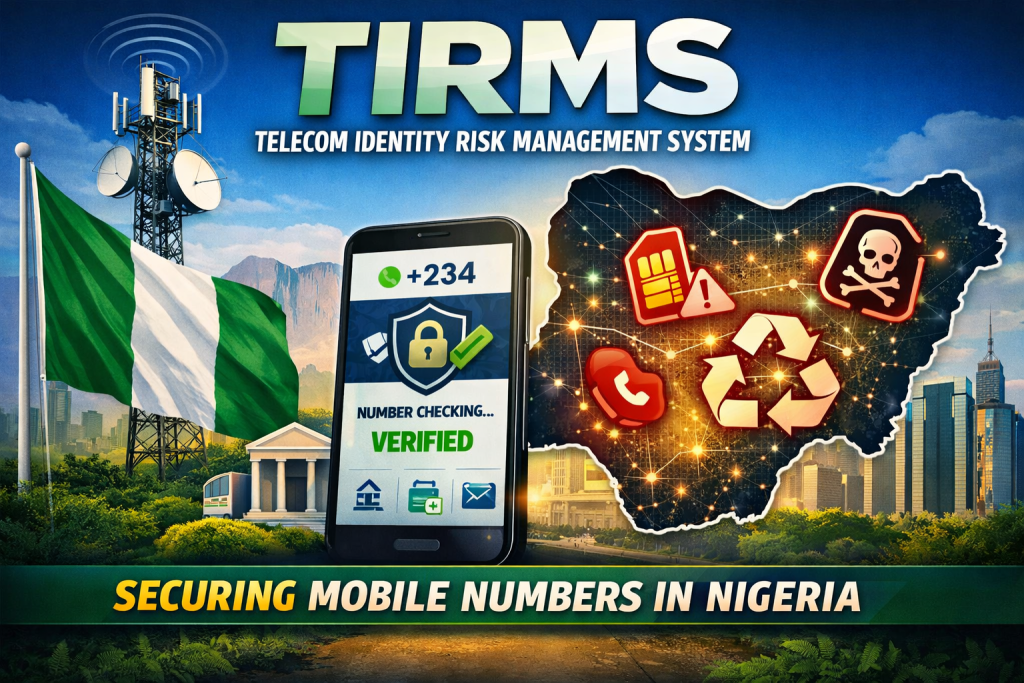
The problem is simple. A phone number can change hands. It can be swapped, recycled, blacklisted or linked to suspicious activity. Yet many institutions still treat the number as a stable identifier long after its status has changed. That gap creates room for fraud, account compromise, identity theft and wrongful trust decisions.
That is the context behind the Nigerian Communications Commission’s Telecoms Identity Risk Management System, or TIRMS. The platform is designed as a central, regulatory-backed system that allows authorised organisations to check the status of a mobile number before granting sensitive access or approving risky actions. In practical terms, it aims to help telecom operators, banks, fintechs and other service providers determine whether a number can still be trusted at a given moment.
The significance of TIRMS lies in what it recognises. Mobile numbers now sit at the centre of Nigeria’s digital trust architecture. Once that reality is accepted, managing the lifecycle risk of those numbers becomes a policy and security priority, not a technical afterthought.
Public information around the platform shows that the NCC has gone beyond mere policy talk. The commission has introduced the initiative publicly, opened industry consultation and linked it to proposed rule changes around line churn, number reassignment and fraudulent SIM use. There is also public technical documentation that points to live integration planning for approved organisations. That means TIRMS should be seen as an active rollout, not as a finished nationwide system that has already reached full adoption.
Its core value is straightforward. When a number has been recently swapped, reassigned or flagged, a bank or digital platform should know that before allowing a password reset, onboarding a new user, approving a transaction or restoring account access. If that information is available in real time and used properly, the chances of fraud can fall sharply.
This is especially relevant in Nigeria, where mobile numbers are deeply embedded in digital and financial services. As more services depend on telecom-linked identity, weak controls around number status become a broader systemic risk. A person may inherit a recycled number and begin receiving messages meant for the former owner. A fraudster may exploit a recent SIM swap to gain access to banking or wallet services. A compromised line may still be treated as a legitimate recovery channel by multiple institutions. These are not isolated telecom problems. They are cross-sector identity risks.
TIRMS is therefore important because it creates the basis for a shared risk signal around a number’s status. It gives regulators and licensed entities a common way to assess whether a number is normal, recently changed, or potentially unsafe for trust-sensitive actions. In theory, that should reduce dependence on stale records and narrow the window that fraudsters exploit.
Still, the platform’s success will depend on three hard issues.
The first is adoption. A system like this only works if the institutions that face the risk actually use it. If banks, fintechs, insurers and digital platforms do not integrate it into their core workflows, the platform may exist without changing outcomes. Nigeria has seen similar problems before, where data-sharing tools were available but not used consistently enough to shift behaviour.
The second is data quality and timing. TIRMS will only be as effective as the information flowing into it. Telecom operators must submit accurate updates quickly. A delay in reporting a SIM swap or a recycled number can weaken the entire control model. In fraud prevention, old data is often almost as bad as no data.
The third is governance. A powerful risk-verification platform needs clear rules on access, purpose limitation, audit trails, consumer protection and redress. Institutions need to know how to use a risk flag appropriately. Consumers need a way to challenge errors. A wrongly flagged number should not lock a legitimate user out of essential services without a fair and timely remedy.
For the NCC, TIRMS marks a broader regulatory shift. It shows the commission responding to the fact that telecoms infrastructure now underpins trust across finance, security and public services. That is a sound direction. The commission is treating the mobile number as part of national digital identity assurance, even if it does not replace formal identity systems such as NIN.
For operators, the platform raises the standard for how churn, reassignment and fraud-related events are managed. For banks and fintechs, it offers a new control layer that could reduce losses tied to number-based fraud. For consumers, it could improve safety if implemented well, though it may also introduce friction where institutions rely too heavily on automated flags without strong review processes.
The strongest conclusion at this stage is that Nigeria is moving in the right direction. TIRMS addresses a real problem and fits the current structure of digital risk in the country. The NCC has shown regulatory intent, technical momentum and cross-sector ambition. But the platform’s true test will come after launch, when enforcement, integration and operational discipline begin to matter more than announcements.
If TIRMS becomes widely used for high-risk events such as password resets, account recovery, number changes and sensitive onboarding, it could become one of the more consequential fraud-control tools in Nigeria’s digital ecosystem. If adoption remains partial or compliance weak, it may end up as a promising platform with limited practical effect.
Nigeria does not need more isolated security tools. It needs trusted systems that connect telecoms, finance and digital services in a disciplined way. TIRMS has the potential to be one of them. Whether it succeeds will depend on how seriously the market treats the mobile number as an identity asset that must be verified continuously, not assumed blindly.
Destiny Young is a Technology and IT Infrastructure Management Executive and Cybersecurity Professional with extensive experience in enterprise systems, digital transformation, and cybersecurity management. He holds a First Class Master of Science degree in Digital Transformation, a Distinction grade Master of Business Administration with a specialisation in Cybersecurity, and a Master of Technology degree in Information Technology. His work focuses on strengthening cyber resilience in organisations and examining the relationship between technology, risk, and business strategy. Destiny is also an active academic researcher with a strong interest in cybersecurity governance and threat mitigation. He writes regularly on digital security issues affecting businesses in Nigeria and contributes to industry discussions on cyber risk management and policy development