

BY | DESTINY YOUNG
Imagine a middle-aged Nigerian named Boniface, living with his family in a neighbouring state.
For several months, Boniface has required specialised medical attention. His local hospital has capable doctors, but it lacks the advanced equipment and specialist team needed to manage his condition. His family begins the familiar and difficult process of arranging treatment abroad.
They calculate the cost of flights, accommodation, medical consultations, diagnostic tests and feeding. They also consider the uncertainty of living in a foreign country while seeking care. Before the first appointment is secured, the family’s savings are almost exhausted.
Then someone tells them that the required specialist care is available in Akwa Ibom State.
They board a short flight into the Victor Attah International Airport. From there, they travel through a peaceful and well-connected environment to the Ibom Medical Corridor. Within the corridor, Boniface receives advanced diagnostic services, specialist consultation and co-ordinated treatment. His wife stays close to the facility, while other members of the family have access to suitable accommodation and essential services.
Boniface does not cross the Atlantic Ocean. His family does not struggle with visa applications or foreign currency. The money they would have spent abroad circulates within the Nigerian economy.
This is an illustrative case, but it captures the future I believe Governor Umo Eno seeks to create through the Ibom Medical Corridor.
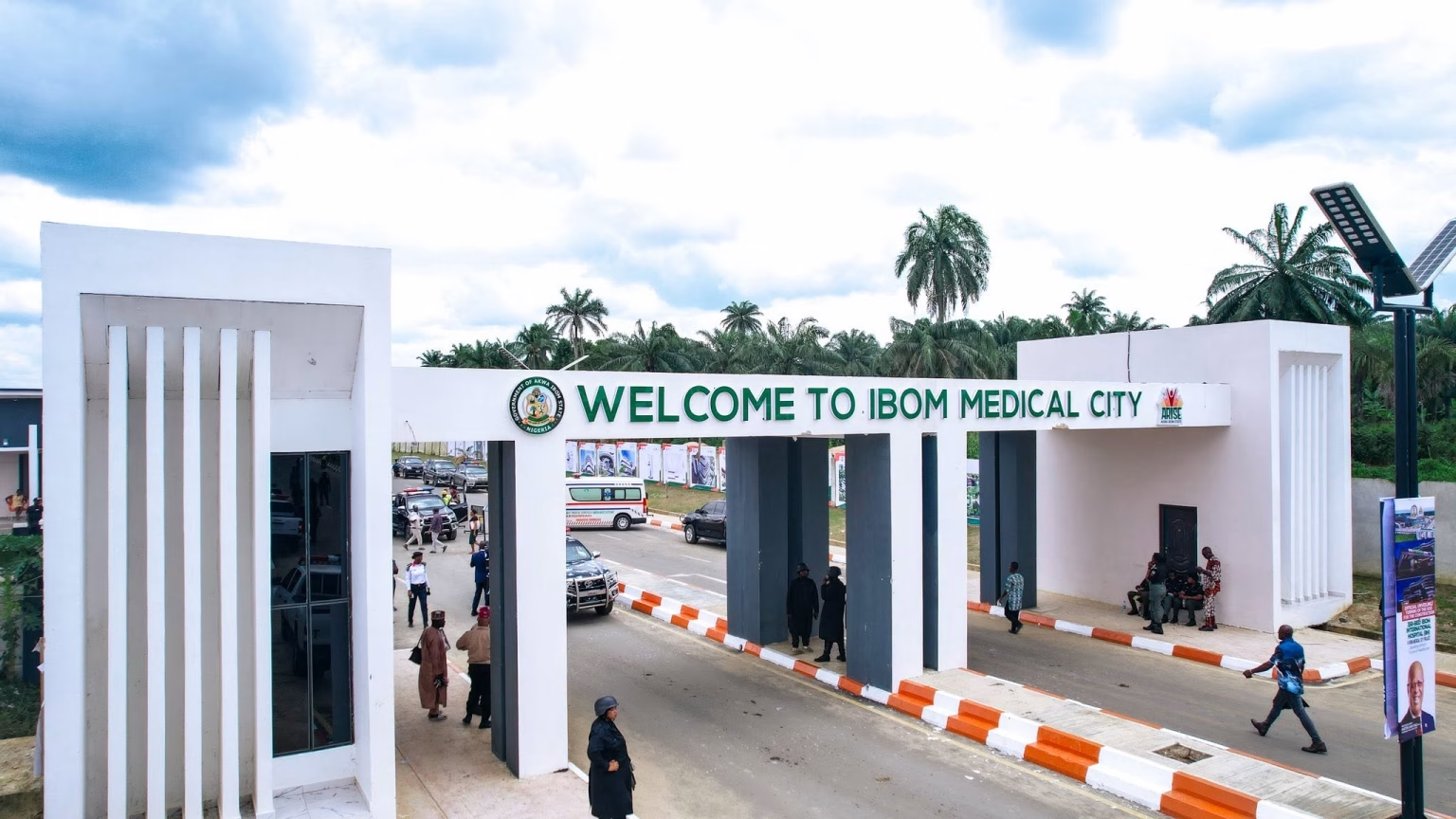
In my view, the project represents a deliberate attempt to build a complete healthcare ecosystem rather than another isolated hospital building. It connects medical care with research, training, accommodation, aviation, hospitality, elderly care and supporting commercial services.
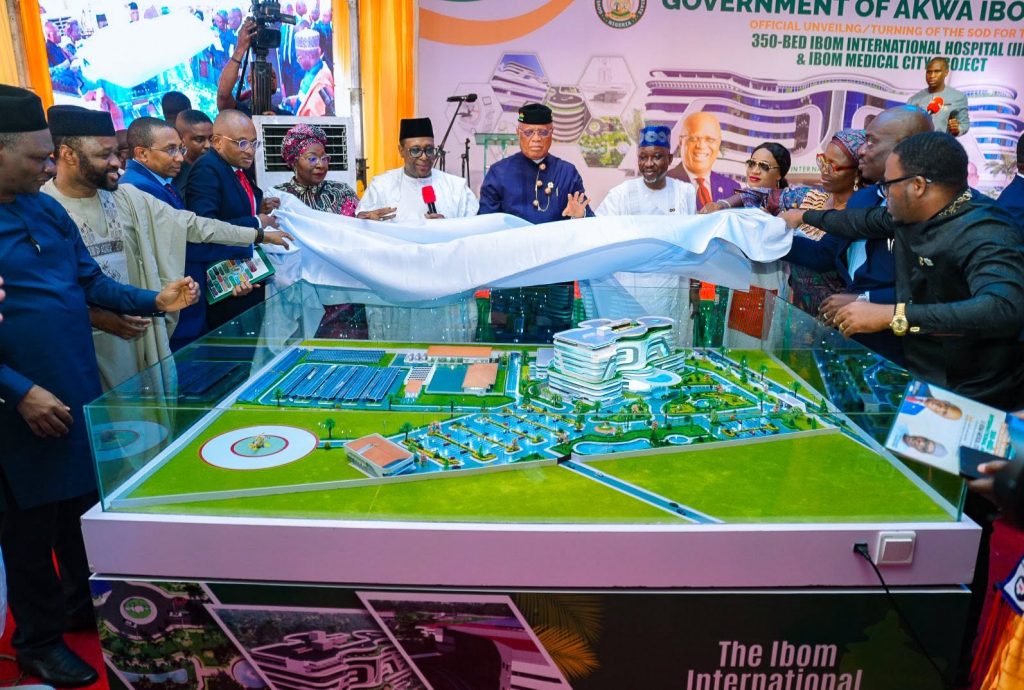
At the centre of this vision is the 350-bed Ibom International Hospital, designed to provide specialised and technology-driven healthcare services. The hospital is planned with 24 clinical departments and facilities for advanced diagnostics, medical research, professional training, innovation and wellness services.
Its significance lies in the problems it seeks to solve.
Every year, many Nigerians travel abroad for medical procedures that could be performed within the country if the right facilities, specialists and management systems were available. This movement places pressure on families and contributes to the loss of substantial financial resources from the Nigerian economy.
Governor Umo Eno’s response is direct. Build the infrastructure. Attract the expertise. Establish the right management structure. Create an environment where Nigerians can receive quality care at home and where patients from other countries can confidently choose Akwa Ibom as a treatment destination.
This, to me, is what gives the Ibom Medical Corridor its mark of distinction.
It is ambitious in size, but its greater strength lies in its integrated design.
The existing Ibom Multi-Specialty Hospital forms part of the corridor’s healthcare foundation. The proposed Ibom International Hospital will expand the range and depth of specialised services available. The ARISE Senior Citizens Centre introduces a structured system of care, recreation and wellness for elderly people.
The planned Medical Village will provide suitable residential accommodation for doctors, nurses, researchers and other health professionals. This will help the state attract and retain skilled personnel, including specialists who may be required to live close to the hospital.
The corridor also benefits from its connection to hospitality and aviation infrastructure. The Four Points by Sheraton Hotel can support visiting families, medical experts, conference participants and health tourists. Ibom Air and the Victor Attah International Airport provide a strategic transportation advantage for patients travelling from other parts of Nigeria and beyond.
These facilities are different parts of one development strategy.
A patient may arrive by air, receive specialist care, undergo rehabilitation and remain within an environment equipped to meet medical, residential and hospitality needs. A visiting surgeon may conduct procedures, train local medical personnel and participate in a research conference without leaving the ecosystem. A pharmaceutical company may establish operations near the corridor to support clinical services and medical research.
This level of integration separates the project from the traditional approach of constructing a hospital without developing the systems needed to sustain it.
The Medical Corridor also carries significant economic potential.
A functioning medical city requires doctors, nurses, pharmacists, laboratory scientists, radiographers, biomedical engineers and health-information specialists. It also creates opportunities for administrators, technology professionals, facility managers, caterers, security personnel, transport operators and maintenance workers.
Its value chain could stimulate pharmaceutical production, medical-equipment servicing, digital-health innovation, research partnerships, hospitality services and professional education.
Young Akwa Ibom people studying medicine, nursing, pharmacy, engineering, information technology and related disciplines could find new career pathways within their own state. Local businesses could provide goods and services to the hospitals, residences, research centres and hospitality facilities operating within the corridor.
The project therefore connects healthcare development with employment creation, knowledge transfer and economic diversification.
Governor Eno’s approach also reflects an important lesson in public leadership. A government must assess existing assets honestly and determine what should be repaired, reorganised or newly developed.
The administration has stated that the Ibom Multi-Specialty Hospital will continue to operate while the new international hospital addresses identified gaps in advanced and quaternary healthcare. This approach recognises the value of previous investments while creating additional capacity for the future.
I see this as a model of continuity rather than destructive competition between administrations.
The Ibom Medical Corridor also fits into the wider ARISE Agenda. It advances health-sector development, infrastructure, tourism, education, investment and job creation within a single strategic location.
The project is supported by other healthcare reforms across the state. The administration has constructed and renovated primary healthcare centres, recruited thousands of health workers and expanded enrolment in the state health-insurance programme. It has also strengthened emergency medical response and continued interventions for vulnerable citizens.
These measures show that the Medical City is not intended to replace community healthcare. Primary-care centres will address common health needs at the local level, while general and secondary facilities will manage referrals within their capacity. The Ibom International Hospital will occupy the specialised end of the system.
A sound health sector needs every level to function.
At the unveiling of the project, the Federal Government, through the Co-ordinating Minister of Health and Social Welfare, Professor Muhammad Ali Pate, pledged support for its successful completion and operation. That endorsement gives the project national relevance and creates opportunities for institutional collaboration.
It also confirms that the ambition behind the Medical City extends beyond Akwa Ibom State.
From my perspective, Governor Umo Eno is positioning the state to become a healthcare destination for Nigeria, the Gulf of Guinea region and other parts of Africa. Akwa Ibom already possesses several competitive advantages. It has a peaceful environment, an expanding aviation sector, quality hospitality facilities and a reputation for cleanliness and order.
The Medical Corridor brings these advantages together around one of humanity’s most important needs, access to quality healthcare.
Ambitious projects must be judged by execution. Buildings must be completed. Equipment must meet international standards. Specialists must be recruited. Clinical systems must protect patients. Management must remain professional and financially responsible.
Governor Eno appears conscious of this responsibility. His administration has presented the hospital as an institution that should become operationally sustainable rather than remain permanently dependent on government subvention.
That goal will require competent management, transparent procurement, reliable maintenance, strong clinical governance and partnerships with reputable medical and academic institutions.
The project’s true distinction will emerge when its modern structures are matched by excellent service.
Return to the story of Boniface.
After receiving treatment, he returns home with improved health and a different impression of Akwa Ibom State. His family speaks about the doctors, the facilities, the orderly environment and the ease of travelling to Uyo.
Another patient hears their story and chooses Akwa Ibom. A specialist accepts an appointment within the Medical City. A researcher begins a clinical study there. A young graduate secures employment in one of its laboratories. A local entrepreneur supplies essential materials to the facility.
One successful medical encounter produces a chain of social and economic value.
That is how a hospital becomes a medical city. That is how a medical city becomes an economic corridor. That is how a government project becomes a lasting institution.
I consider the Ibom Medical Corridor Governor Umo Eno’s statement that Akwa Ibom should prepare for a future in which healthcare, knowledge, technology and investment work together.
It is bold in conception. It is strategic in location. It is broad in economic potential. It also demonstrates a willingness to pursue projects whose benefits may extend far beyond one political term.
The people of Akwa Ibom have a stake in its success. Health professionals must contribute their expertise. Communities must protect the investment. Contractors must deliver quality work. Public officials must ensure accountability. Citizens must judge the project through facts, progress and its eventual impact.
When completed and properly managed, the Ibom Medical Corridor could reduce the need for overseas treatment, retain healthcare spending within Nigeria, create skilled employment and establish Akwa Ibom as a recognised centre for specialised medicine.
Governor Umo Eno has placed an ambitious vision before the state.
Its name is the Ibom Medical Corridor.
Its purpose is to save lives, develop human capacity and build a new pillar of economic prosperity.
Its mark of distinction will be measured in every patient treated, every professional trained, every job created and every family spared the burden of travelling abroad in search of quality healthcare.
—
Citp’ Destiny Young, FIIM, MCPN, a Political and Digital Communication Expert, serves as the Special Assistant (New Media & Digital Communication) to the Executive Governor of Akwa Ibom State, H.E. Gov Umo Umo, PhD