



The Federal Government’s 2026 fiscal policy measures cut import duties on food staples, vehicles, machinery and industrial inputs. The move could ease pressure on prices, lower transport costs and support production, but ordinary Nigerians will feel the impact only if the savings reach the market.
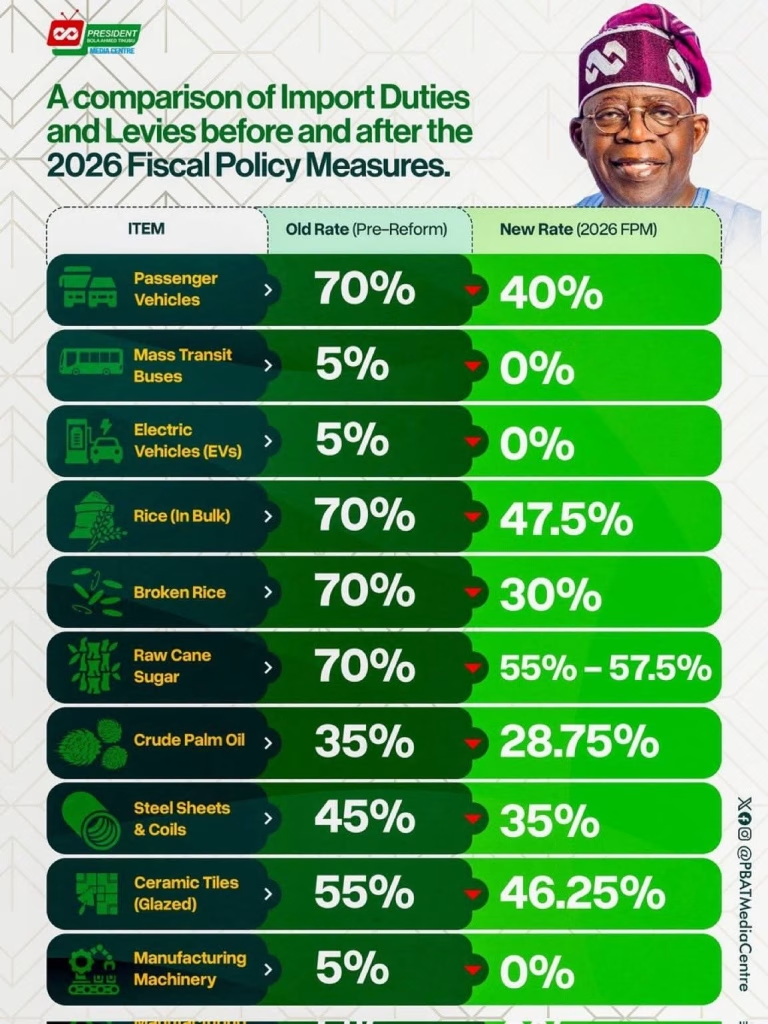
President Bola Tinubu’s administration has unveiled one of its clearest cost-of-living interventions yet, a broad reduction in import duties on selected goods under the 2026 fiscal policy measures. On paper, the logic is simple. If it becomes cheaper to import key goods and industrial inputs, businesses should face lower costs and consumers should see some price relief.
That is the theory. The real question is whether the benefits will move beyond policy documents and port entries to the markets, transport parks and households where Nigerians feel inflation every day.
The duty cuts cover products with direct relevance to daily life and economic activity. Passenger vehicles now attract a lower import duty. Mass transit buses, electric vehicles and manufacturing machinery have been granted full duty exemption. Rice, broken rice, raw cane sugar, crude palm oil, steel sheets and ceramic tiles also recorded significant reductions.
For ordinary Nigerians, the most important parts of this policy are not the changes affecting private car buyers. They are the measures tied to food, transport and production. Those are the areas that shape how far salaries stretch, how much traders spend to move goods, and how much households pay for basic needs.
Rice is central to this conversation. It is one of the most consumed staples across the country. Any reduction in the landed cost of imported rice has the potential to ease retail prices, at least in theory. The same applies to broken rice, which is widely consumed by lower-income households and food vendors. If importers pass on the lower duty costs, some relief could reach consumers. If they do not, then the policy will remain a technical reform with little everyday impact.
Transport may be where the policy has the fastest visible effect. The zero-duty treatment for mass transit buses is a strong signal. Public transportation drives the cost structure of urban life in Nigeria. When transport fares go up, workers spend more just to get to work, traders pay more to move goods, and food prices rise because logistics costs rise too. Cheaper bus imports could help transport operators expand fleets, replace ageing vehicles and reduce cost pressure on passengers over time.
That matters now because Nigeria is still dealing with inflation risks linked to energy costs. Reuters reported this week that fuel prices have risen sharply as fresh geopolitical tensions disrupted oil markets, adding new pressure to household budgets and business costs. Even though inflation had eased earlier this year, the resurgence in fuel costs threatens that progress and makes any measure aimed at reducing other cost drivers more important.
The manufacturing side of the policy may also prove significant. Zero duty on machinery and lower tariffs on industrial inputs such as steel sheets and tiles could reduce production costs for factories, workshops and construction firms. That does not produce instant price drops at the market stall, but it could improve margins, support output and reduce the pace of price increases over time. In an economy where high production costs have squeezed both manufacturers and consumers, that is a useful intervention.
Still, Nigerians should not assume that lower import duties automatically mean lower prices. Import costs are only one part of the final retail price. Exchange rate volatility, port charges, haulage costs, customs delays, warehousing fees and dealer mark-ups all shape what consumers eventually pay. If the naira weakens or logistics costs remain high, part of the duty relief may disappear before it reaches the final buyer.
That is the central weakness of tariff-based relief. It can create room for lower prices, but it cannot force market actors to pass on the savings. Importers may keep part of the margin. Distributors may adjust slowly. Retailers may still price according to scarcity, demand and expected future costs rather than immediate reductions in import duty.
There is also the question of domestic production. Lower import duties may help consumers in the short term, but they can create pressure for local farmers, processors and manufacturers if imported goods become more competitive than locally made alternatives. Rice, sugar and palm oil are especially sensitive in this regard. Nigeria has spent years promoting import substitution and local value chains in these sectors. A poorly managed tariff reduction could weaken that long-term strategy if local producers face cheaper foreign competition without adequate policy support.
That does not mean the new measures are misguided. It means they need balance. If government wants to lower prices and protect domestic industry at the same time, it must pair tariff relief with support for local producers. That includes better access to finance, lower energy costs, improved transport infrastructure and stronger agricultural productivity. Without that second half, tariff cuts may ease inflation briefly while weakening local capacity in the background.
The same tension exists in the vehicle market. A lower duty on passenger vehicles may improve affordability for some buyers, but its wider social value is less direct than zero duty on buses or machinery. The public interest case is much stronger where the policy reduces the cost of moving people or making goods than where it mainly helps middle-income consumers buy imported cars.
For common Nigerians, the likely impact will be uneven. Urban commuters may benefit first if transport operators take advantage of cheaper bus imports. Rice consumers could see some moderation in prices if importers transmit the lower costs. Manufacturers and artisans may gain from cheaper machinery and inputs. Builders may see some relief from lower costs on selected materials. But few households should expect an immediate and dramatic fall in the overall cost of living.
The real test is execution. Customs authorities must implement the new rates clearly and consistently. Port and logistics bottlenecks must not swallow the gains. Government must watch for profiteering and anti-competitive behaviour. There also needs to be enough market transparency for consumers and businesses to know when duty cuts should be reflected in prices.
This is why the intervention should be viewed as a potentially useful measure, but not a complete solution. It can reduce pressure. It can support productive activity. It can create space for lower prices. But it cannot by itself solve the structural issues that keep prices high in Nigeria.
The strongest value of the policy lies in three areas. Food, transport and production. If the duty cuts bring down the cost of staple imports, improve access to buses and reduce factory input costs, then many Nigerians could feel modest but real relief. If the savings remain trapped between the ports and the distributors, the public will hear about reform without experiencing it.
That is the difference between a policy announcement and an economic outcome. Nigerians do not measure reforms by tariff schedules. They measure them by the price of rice, the cost of transport and what remains in their pockets after a week of trying to survive.









So does this mean, rice can now be imported into Nigeria?… Rice is no longer considered as contraband?