

By | Dada Michael
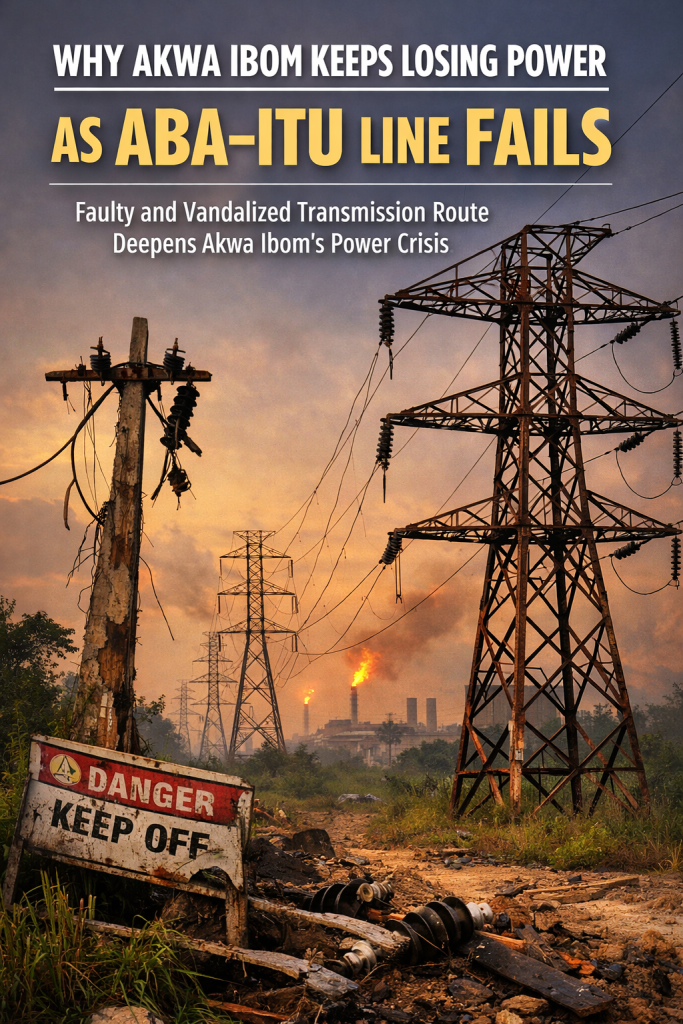
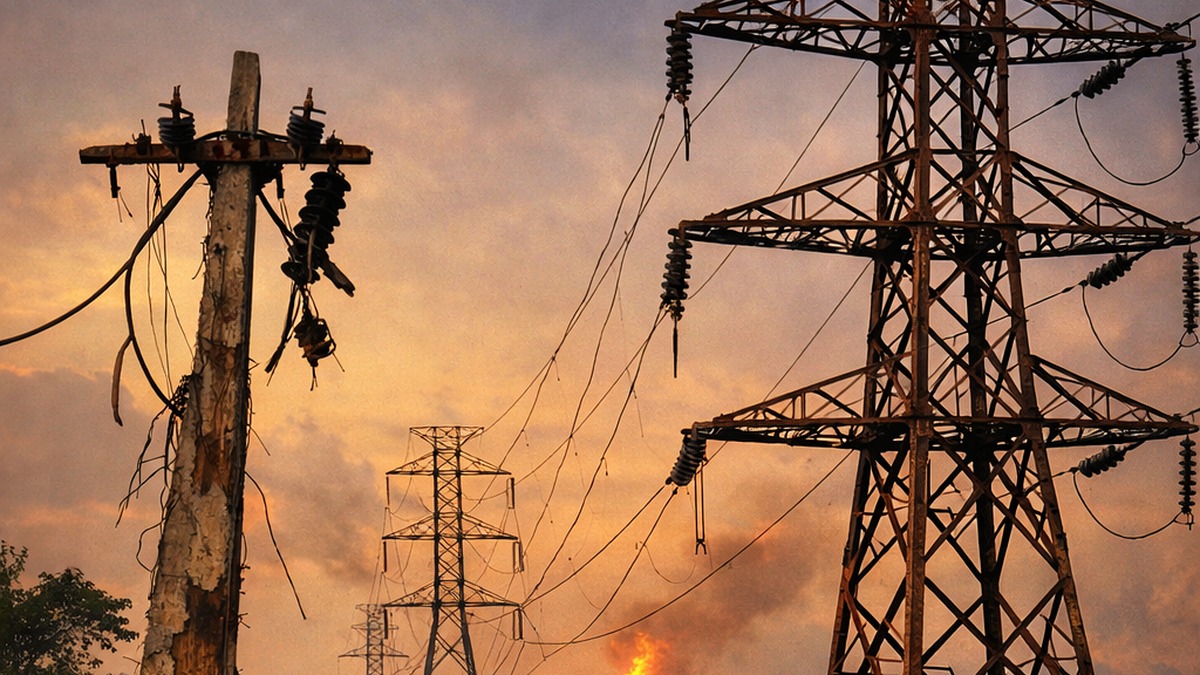
Persistent electricity outages in Akwa Ibom State are being driven by deeper weaknesses in the transmission network, with the ageing Aba-Itu 132kV line now under growing pressure as one of the state’s main power supply routes. With the vandalised Itu-Adiabo line still unavailable and concerns rising over the security of other transmission assets, industry officials say the state’s electricity stability depends on urgent repairs, better infrastructure protection, and steady support from Ibom Power.
Akwa Ibom receives electricity from three main sources, the national grid through the Aba-Itu 132kV transmission line, the Itu-Adiabo transmission line from Calabar, and the state-owned Ibom Power Plant. In practical terms, this means supply into the state can come from Abia State, Calabar, or from Ibom Power.
That arrangement has, however, been weakened over time. The Itu-Adiabo line from Calabar has remained out of service after vandalism, leaving the old Aba-Itu transmission line as the main route for grid electricity into the state, alongside generation from Ibom Power.
According to power sector officials, the frequent faults on the Aba-Itu line are largely due to the age and condition of the infrastructure. The line, built decades ago, is said to have limited capacity and now requires reconductoring to improve reliability and stabilise supply.
The difficulty is that major work cannot easily begin on the Aba-Itu line while the Itu-Adiabo route is still unavailable. If repairs start now without an alternative grid source in place, Akwa Ibom could temporarily lose access to grid electricity altogether.
That has brought renewed focus to the need for a phased solution. One long-term option is to first rehabilitate the Itu-Adiabo line so the state can retain at least one active grid supply route before work begins on the ageing Aba-Itu corridor.
An immediate option under discussion is to proceed with repairs on the Aba-Itu line and rely on Ibom Power to support supply during the period of reconstruction. Officials say the reconductoring work could take about three months. During that period, if Ibom Power has steady gas supply, it could generate electricity and supply the state in island mode.
Such an arrangement would mean Akwa Ibom depends heavily on Ibom Power throughout the repair window, because the Aba-Itu line would be under maintenance and the Itu-Adiabo line would still be out of service.
That option also comes with its own risks. Concerns remain over the safety of the Ikot Abasi-Eket transmission line, which evacuates power generated by Ibom Power. If that line is vandalised or damaged while repairs are ongoing on the Aba-Itu corridor, the state could face a full blackout.
Power officials have pointed to past incidents to show how serious that risk can be. When the Ikot Abasi-Eket line was vandalised late last year, urgent intervention was needed to restore the line and keep supply from worsening.
The challenge is not limited to ageing infrastructure and vandalism. Some transmission projects in Akwa Ibom have also suffered setbacks linked to youth unrest and community demands for compensation, slowing efforts to strengthen the network and expand power reliability across the state.
Stakeholders say this makes public cooperation essential. There are growing calls for the Akwa Ibom State Government to work more closely with communities to protect electricity infrastructure and help residents understand the cost of vandalism to homes, businesses, and public services.
For now, the way forward appears clear. Authorities need to support repairs on the ageing Aba-Itu line, restore the vandalised Itu-Adiabo route, ensure Ibom Power has enough gas to operate effectively in island mode, and improve protection for transmission assets across the state.
For consumers and businesses, the repeated faults show that the state’s electricity problems go beyond routine distribution failures. The deeper issue lies in the transmission backbone feeding Akwa Ibom. Until critical lines are repaired, backup routes restored, and infrastructure better secured, the risk of recurring outages is likely to remain.
Michael, writes from Ibom Power Plant Company