

By | Destiny Young | TechNews – April 18, 2026
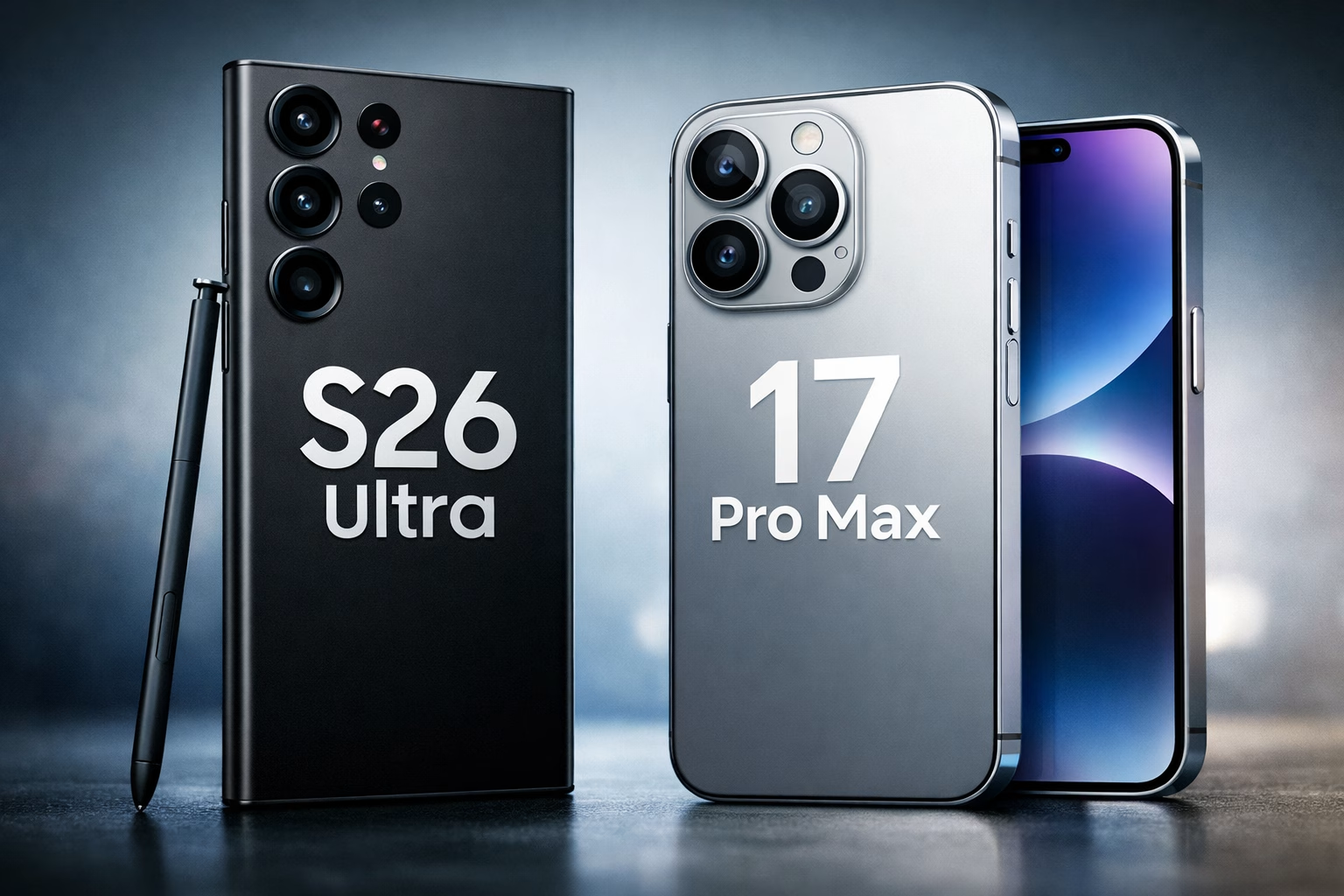
When people compare Apple and Samsung, they often focus on cameras, battery life, display quality and price. The more important contest is software. This is where Apple usually pulls ahead. The reason is not that Samsung cannot build strong software. It can, and in recent years it has improved sharply. The reason Apple tends to lead is structural. It controls the full stack, the hardware, the chipset, the operating system, the app ecosystem and the update pipeline. Samsung still operates inside the broader Android system, where Google, Samsung, chip vendors, mobile carriers and regional variants all affect how quickly updates move.
Apple’s biggest advantage is central control. When Apple releases a new iOS version, it pushes that update directly to supported iPhones at the same time across a large global install base. Apple also publishes a single compatibility path for the latest iOS release, and its security release system includes Rapid Security Responses and newer background security improvements for the latest supported software. That gives Apple a cleaner, faster and more uniform rollout model.
Samsung’s model is more complex. Even though Samsung now offers up to seven generations of Android OS upgrades and seven years of security updates on newer flagship lines such as the Galaxy S24 family, the company still manages devices across monthly, quarterly and biannual security tracks. That means support is longer than before, but not equally fast or equally frequent across all models. Premium phones usually get better treatment than budget phones, and rollout timing can still vary by region and carrier.
This is the core reason Apple is seen as leading. Apple’s update promise is not only about duration. It is about simultaneity and consistency. An iPhone user with a supported device usually knows the update will arrive directly from Apple without waiting for a carrier or a separate manufacturer skin to be adapted. On Samsung, the path is longer. Google publishes Android security bulletins and platform fixes, then manufacturers and chipset partners integrate them, after which carriers may still influence timing in some markets. That extra chain creates friction.
Security is where this difference matters most. Apple can ship security fixes quickly between larger OS releases through Rapid Security Responses. It now also supports lightweight background security improvements on newer software branches. That means Apple can address some threats without waiting for a full feature update cycle. Samsung also issues security patches and publishes its own security update scope, but the cadence depends on the device tier and support phase. In practice, Apple’s security posture feels more immediate to ordinary users because the process is simpler and more centralised.
Another reason Apple leads is device fragmentation. Apple sells relatively few iPhone models each year and keeps its hardware portfolio tight. Samsung sells a far broader range, from foldables and premium flagships to mid-range and entry-level devices across many markets. That range helps Samsung win reach and volume, but it makes update management harder. Supporting many chipsets, screen sizes, regional radios and price tiers raises testing costs and slows delivery. Apple’s narrower lineup gives it a major operational advantage. Samsung’s progress on update longevity is real, but complexity still works against it.
Apple also benefits from software discipline. Because it owns iOS, it does not need to wait for another company’s platform roadmap before finalising its own release cycle. Samsung must build One UI on top of Android, then optimise it for its own hardware and features. That adds another integration layer. Samsung can innovate inside that layer, and often does, but each added layer is another place where delays or bugs can appear. In software operations, fewer dependencies usually mean faster execution.
That said, the gap is no longer as wide as it once was. Samsung has become the strongest Android OEM on long-term support. Its seven-year promise for newer flagship devices is a major shift, and far better than the shorter support windows that defined much of the Android market in earlier years. For buyers who want an Android phone with serious long-term support, Samsung is now one of the safest choices. Apple still leads in coherence, but Samsung has narrowed the distance in duration.
There is also a feature trade-off. Samsung sometimes moves faster in customisation, multitasking options and hardware form factors such as foldables. Apple is usually more conservative. So if the question is who offers more flexibility, Samsung has a strong case. But if the question is who delivers a cleaner and more predictable software lifecycle, Apple still has the stronger argument. Stability, timing and uniformity matter more in updates than the number of features on a spec sheet.
The business lesson is simple. Apple leads because it built an update system, not just an operating system. It controls the release path end to end. Samsung has improved its support policy, but it still works inside a more fragmented ecosystem with more moving parts. That difference affects speed, consistency and trust. For most users, that is why Apple is still seen as the benchmark in software updates, even when Samsung matches or approaches it on support length.