


DR. WISDOM ENANG LAUDS GOVERNOR UMO ENO’S ₦123.5 BILLION ROAD INVESTMENT AS A CORNERSTONE FOR SUSTAINABLE ECONOMIC GROWTH IN AKWA IBOM STATE
SAMPSON ENYONGEKERE | UYO
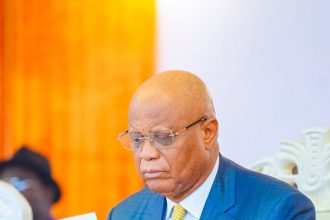
An internationally recognized policy strategist and Adjunct Professor at the University of North Dakota, USA, Engr. (Dr.) Wisdom Patrick Enang, has described Governor Umo Eno’s ₦123.5 billion road infrastructure investment as a defining expression of economic statecraft, one that repositions public infrastructure from routine expenditure into a deliberately designed framework for long-term value creation, spatial integration, and sustained productivity growth.

Speaking in Uyo on Friday, April 24, Dr. Enang emphasized that the administration’s approach reflects a sophisticated understanding of development economics, where growth is not incidental but deliberately engineered through strategic capital deployment aimed at removing structural bottlenecks, expanding access, and unlocking productive capacity across key sectors of the economy.
“Strong economies are not declared into existence; they are constructed through deliberate and intentional choices. Roads remain the most visible expression of economic intelligence, as they determine the efficiency with which value is created, accessed, and moved.”
Expatiating further, the erudite scholar noted that the strategic rollout of over 167 kilometres of priority road corridors represents a decisive transition from fragmented interventions to integrated connectivity planning.
“By linking agricultural belts to urban markets and connecting production nodes to consumption centres, the state is systematically dismantling long standing spatial inefficiencies that have constrained trade flows, elevated transaction costs, and suppressed rural prosperity.”
The globally respected energy expert further observed that empirical development evidence consistently positions transport infrastructure as one of the strongest determinants of economic expansion. He further explained that improved road infrastructure shortens delivery timelines, reduces transport expenses, widens market access, and strengthens price outcomes for producers, particularly in rural and semi-urban areas.
“When distance is reduced as an economic barrier, opportunity ceases to be limited by geography and becomes defined by capacity.”
Situating the investment within the broader framework of the ARISE Agenda, the renowned development strategist described the initiative as a precise alignment between policy ambition and infrastructural execution. He stressed that agricultural transformation, rural development, and enterprise expansion cannot materialize at scale without efficient transport systems that guarantee seamless movement of goods, services, and people.
“For the farmer, roads determine access to markets. For the entrepreneur, they determine scalability. For the investor, they determine confidence.”
Beyond immediate economic functionality, the Akwa-born, British-trained Chartered Engineer underscored the significant employment and human capital dividends inherent in the approved road projects.
According to him, infrastructure programmes of this magnitude function as dual engines of development, generating direct employment while simultaneously strengthening technical capacity and vocational exposure among the workforce.
“Every kilometre of road constructed represents more than physical infrastructure. It represents expanded livelihoods, transferred skills, and broadened pathways to economic inclusion.”
Building on this, the globally respected economic egghead emphasized that the quality of infrastructure ultimately determines the depth and durability of investment inflows. He further posited that the administration’s parallel commitment to large-scale road development and the prompt settlement of contractor obligations reinforces fiscal credibility and signals disciplined governance, thereby strengthening investor confidence in Akwa Ibom State’s economic environment.
“Capital does not respond to rhetoric. It responds to certainty. Infrastructure provides the foundation, but disciplined governance sustains investor confidence.”
Expanding the analytical perspective, Dr. Enang explained that the true economic value of road infrastructure transcends physical visibility, residing instead in its capacity to stimulate industrial clustering, optimize logistics ecosystems, and integrate fragmented local economies into cohesive and competitive value chains.
“Roads do not merely connect locations. They align economies, synchronize productivity, and unlock latent value across entire regions.”
Drawing comparative insights from high-performing economies, the public reform advocate maintained that sustained economic transformation across global development success stories has consistently been anchored on deliberate, long-term infrastructure expansion. He further observed that Akwa Ibom is increasingly aligning with this proven trajectory through disciplined and forward-looking investment choices.
The Ethical and Attitudinal Reorientation Czar, however, cautioned that the full developmental dividends of such investments are contingent on sustained policy continuity and disciplined execution. He stressed that infrastructure-driven growth is cumulative in nature, requiring consistency over time to mature into enduring economic transformation.
“Development is not an event; it is a process. Its returns are maximized only when vision is sustained, execution is disciplined, and policy direction remains consistent.”
In his concluding remarks, Dr. Enang affirmed that the ₦123.5 billion road investment stands as one of the most consequential economic interventions in recent years, firmly positioning Akwa Ibom State for enhanced competitiveness, deeper economic integration, and sustained long-term prosperity.
“Governor Umo Eno is not simply constructing roads. He is engineering the structural foundations of a more productive, connected, and prosperous future.”
He expressed confidence that with sustained momentum, institutional alignment, and disciplined implementation, Akwa Ibom State will continue its evolution into a model sub-national economy where infrastructure, governance, and strategic intent converge to deliver enduring development outcomes.