

Beyond the GDP Mirage: A Strategic Roadmap for Prosperity in Nigeria and Africa
By Ephraim Okon, PhD, Esq
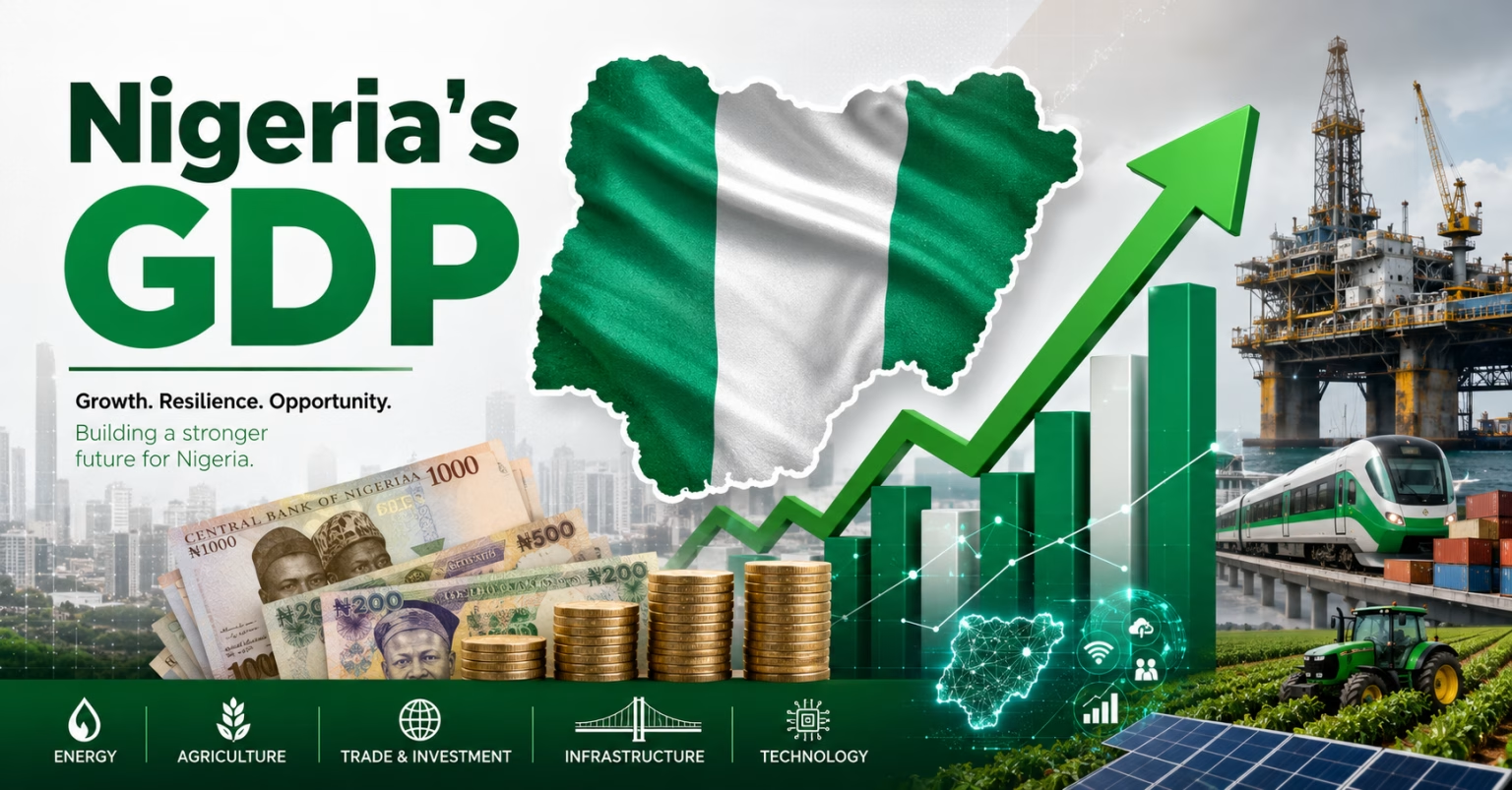
The release of the 2026 HelloSafe Prosperity Index has fundamentally challenged the traditional metrics of national success across the African continent, signaling an end to the era of “growth without development.” For decades, African policymakers have treated Gross Domestic Product (GDP) as the definitive yardstick of power, often celebrating percentage increases in output as synonymous with progress. However, as the latest global data suggests, GDP is frequently a mirage—a macro-level aggregate that reflects industrial output, oil exports, and multinational activity while effectively masking the fractured, lived reality of the ordinary citizen. The limitations of GDP are most glaring in resource-dependent economies where wealth remains “top-heavy.” To correct this, the 2026 index utilizes a multidimensional formula that integrates the Human Development Index (HDI) and income equality alongside Gross National Income (GNI). This shift is critical because while GDP measures what is produced within a country’s borders, GNI measures the wealth that actually stays with its people. By weighing these factors, the index exposes a profound “Prosperity Gap”—a chasm between a nation’s theoretical economic weight and its inhabitants’ actual quality of life.
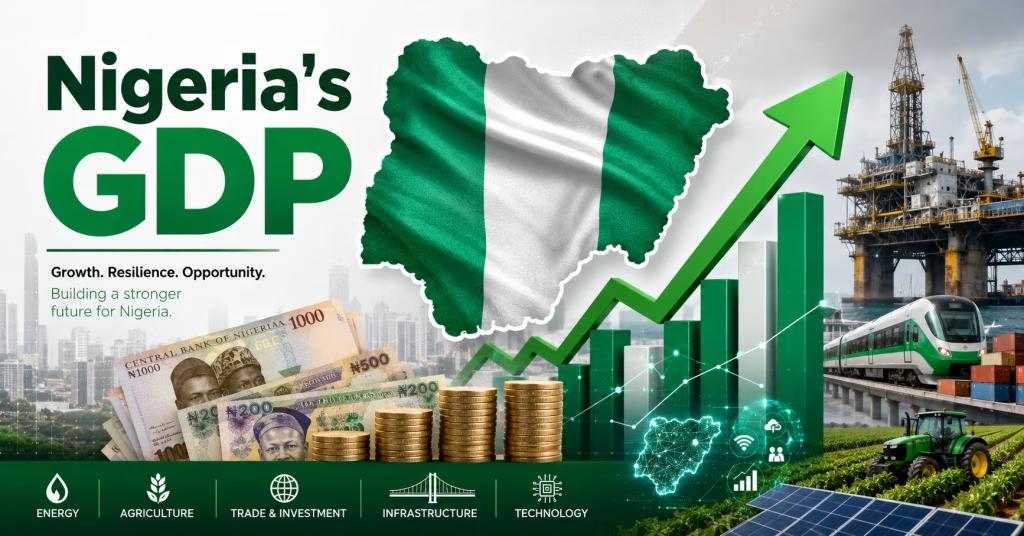
For large economies, particularly Nigeria, this gap can no longer be ignored. As the continent’s industrial giant, Nigeria has long relied on its GDP to claim regional leadership. Yet, the 2026 data reveals that when wealth is measured by how broadly it is shared and how effectively it is converted into health and education, the “giant” is being outperformed by smaller, more socially balanced neighbours. This realization serves as a powerful analytical pivot: it suggests that the true measure of a nation’s strength is not the size of its treasury, but the resilience and capability of its minds. The “Prosperity Gap” is, in essence, a human capital gap, and closing it requires a total reimagining of what it means to be the richest and wealthiest nation in Africa.
The African Landscape: Lessons in Distribution
The African landscape in 2026 is defined by a sharp divide between wealth creation and wealth distribution. At the zenith of the regional panel, the Seychelles (98.09) and Mauritius (77.09) have achieved near-perfect scores by successfully pairing economic growth with aggressive social investment. These nations serve as the continent’s “Very High Human Development” benchmarks, demonstrating that smaller, diversified economies can outperform giants when they prioritize education and health.
Perhaps the most instructive model for Nigeria is Algeria, which ranks third in Africa. Despite having a more modest GDP than the continent’s oil-rich titans, Algeria’s standing is secured by the most equitable income distribution in the region. This reinforces a critical policy truth: a nation’s prosperity is dictated not by the wealth of its elite, but by the breadth of economic participation at the grassroots.
The Nigeria Paradox: A Structural Misalignment
For Nigeria, the index provides a startling analytical wake-up call, placing the continent’s largest economy 13th in Africa with a score of 22.93. We currently trail behind smaller neighbour’s such as Ghana, Cape Verde, and Mauritania. This “Nigeria Paradox” is further validated by the World Bank’s 2026 Human Capital Index Plus (HCI+), which notes that learning and health deficits are costing Nigerian children roughly 51% of their potential future earnings.
While the IMF’s April 2026 World Economic Outlook projects a stabilizing real GDP growth of 4.1%, the UNDP’s 2025 Human Development Report reminds us that Nigeria’s HDI of 0.560 remains an anchor dragging down our prosperity score. The data indicates that as long as the benefits of growth are eroded by inflation and captured by a small percentage of the population, Nigeria will remain stagnant in prosperity standings, regardless of its industrial output.
Policy Synergy: Aligning the Renewed Hope and ARISE Agendas
To bridge this gap, Nigeria requires a vertical alignment of its governance frameworks. At the federal level, the Renewed Hope Agenda seeks to reset the national economy through diversification and social safety nets. At the sub-national level, Akwa Ibom State’s ARISE Agenda provides a localized laboratory for these ideals, focusing specifically on grassroots mobilization and human capital. The success of these policies hinges on a transition from “Physical Infrastructure” to “Human Infrastructure.” The first pillar of this transition involves a shift in focus from GDP to Gross National Income (GNI). Economic success must be measured by the retention of wealth within the borders. This requires a deliberate move toward local value-addition in agriculture and solid minerals, ensuring that profits circulate among Nigerian households rather than being exported—a distortion the index identifies as a primary reason for “paper wealth” in economies like Ireland.
The “Investment in Minds” as a Strategic Lever
Furthermore, Nigeria must treat the “Investment in Minds” as its primary lever for long-term stability. Drawing from the successful models in Northern Africa and the Island states, the national strategy must move beyond central planning to ward-level empowerment. The Renewed Hope Agenda, through its commitment to social investment, finds its practical expression in the ARISE Agenda’s focus on entrepreneurship, skills acquisition, agricultural revolution, education, vocational training and primary healthcare.
By treating each of Nigeria’s 8,809 wards as an independent “prosperity cell,” the nation can begin to lift its national HDI from the bottom up. However, this shift requires moving from budgetary allocation to verifiable last-mile implementation. The path to global credibility is paved by ensuring that the student in a remote village has the same access to digital literacy and maternal health as a resident of the capital city.
Fiscal Discipline and the Reduction of Poverty
The final requirement for global credibility is a commitment to fiscal harmonization and the reduction of relative poverty. Multiple taxation and excessive levies on micro-businesses act as a structural ceiling on prosperity. By reducing these burdens and adopting decentralized economic models—such as the “Waste-to-Wealth” and circular economy initiatives being piloted in Akwa Ibom—Nigeria can foster a more egalitarian distribution of resources. These initiatives serve as a useful laboratory for reform, provided they maintain a focus on measurable impact and transparency rather than just political intent.
The 2026 HelloSafe Prosperity Index serves as an empirical testament that true national wealth is not an accidental byproduct of natural resource endowment, but the direct result of deliberate, human-centric policy choices. Historically, nations with vast mineral deposits have often fallen into the “resource curse” trap, where high GDP figures from raw exports create a facade of wealth while the majority of the population remains trapped in a cycle of poverty. The 2026 data shatters this illusion, proving that if Nigeria is to ascend from its current 13th-place ranking to a position of leadership in African prosperity, the governing philosophy must undergo a fundamental shift: we must move from an obsession with what we are building to a radical commitment to who we are building for.
The strategic alignment of the Renewed Hope Agenda at the federal level and the ARISE Agenda in Akwa Ibom State represents the necessary pivot toward this human-centric model. By harmonizing macroeconomic stability with aggressive grassroots mobilization, Nigeria is beginning to treat its population not as a demographic burden to be managed, but as its most valuable sovereign asset. This synergy ensures that the bricks and mortar of infrastructure—the roads, schools, and hospitals—are not merely empty monuments to expenditure, but are vital conduits for human development and economic inclusion. Investing in the intellectual and physical health of the citizen is the only proven mechanism to ensure that domestic markets remain resilient against global volatility and that governance remains relevant to the lives of the people. When a government prioritizes the Investment in Minds—through vocational excellence, digital literacy, and primary healthcare—it creates a self-sustaining ecosystem of productivity. As human capital appreciates, the necessity for government intervention in the market diminishes; a healthy, educated populace naturally innovates, trades, and grows.
Ultimately, the lesson of 2026 is that when a nation prioritizes its people, the markets eventually take care of themselves. By bridging the “Prosperity Gap” through equitable distribution and a shift toward human infrastructure, Nigeria can finally transform its vast potential into a lived reality for every citizen. When leadership moves beyond the optics of construction to the substance of empowerment, it ceases to be mere administration and becomes true leadership. That is how governance transcends politics—and that is how it truly earns its name.
About the Author:
Abom Ephraim Okon, PhD, Esq is Special Assistant to the Governor of Akwa Ibom State on Grassroots Mobilisation and a development policy analyst writing in his personal capacity.
Data sources: HelloSafe Prosperity Index 2026; World Bank Human Capital Index Plus (HCI+) Feb 2026; IMF World Economic Outlook April 2026; UNDP Human Development Report 2025.
Feedback: [email protected]