

By | Destiny Young
Akwa Ibom State’s decision to establish the Akwa Ibom State Electricity Regulatory Commission and the Akwa Ibom State Electrification Agency marks a defining step in the state’s power reform journey.
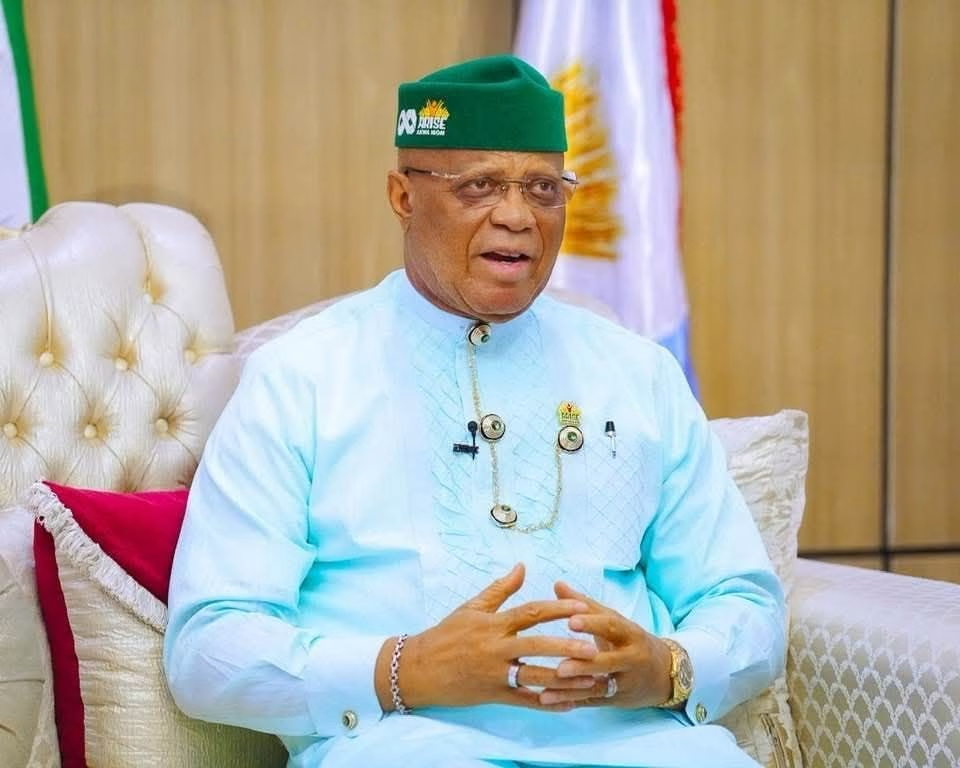
Governor Umo Eno’s reference to the two institutions in his 2026 Easter Broadcast underscores their importance. They are not symbolic bodies. They are the agencies expected to drive the legal and administrative process for Akwa Ibom to begin taking greater control of electricity generation, distribution and access within the state.
This matters because power reform depends on institutions. A modern electricity market cannot function effectively without a regulator and an implementation agency. The regulator sets the rules. The electrification agency helps deliver access, especially to underserved communities.
The Akwa Ibom State Electricity Regulatory Commission is expected to provide the regulatory framework for the state’s electricity market. Its role will be crucial in licensing, compliance, tariff oversight, market monitoring and consumer protection. A credible regulator can help create order, reduce uncertainty and build investor confidence. That is essential if the state wants to attract private capital into power generation, distribution networks and related infrastructure.
The Akwa Ibom State Electrification Agency serves a different but equally strategic purpose. While the regulator oversees the market, the electrification agency can focus on extending power access to communities that remain underserved or unserved. That includes rural communities, growth corridors, productive clusters, schools and healthcare facilities. In practical terms, this agency can help ensure that electricity reform does not stop at policy design but reaches the people and places that need power most.
Akwa Ibom stands to benefit in several important ways.
First, the state could improve energy security. For too long, many states have had limited influence over electricity outcomes despite the direct impact of poor power supply on local economies. With the right institutions in place, Akwa Ibom can begin to shape a more coordinated and state-focused electricity future.
Second, the economy could gain from more reliable and better planned electricity supply. Businesses depend on stable power to cut operating costs, improve productivity and reduce dependence on costly alternatives. Better electricity can support small businesses, manufacturers, agro-processors, hospitality operators, digital enterprises and service providers across the state.
Third, the new agencies can improve Akwa Ibom’s investment appeal. Investors are more likely to commit funds where they see legal clarity, regulatory stability and clear execution structures. By creating both a regulator and an electrification agency, the state is signalling seriousness of purpose. That sends a positive message to developers, financiers and technical partners.
Fourth, communities could benefit from wider access to electricity. Electrification is about more than wires and substations. It affects healthcare delivery, education, water supply, small-scale enterprise and quality of life. A dedicated agency focused on access can help bring these benefits to communities that have often remained outside the reach of stable power.
Governor Umo Eno deserves commendation for the strategic direction behind this move. Rather than treat electricity reform as a talking point, his administration appears to be building the institutional foundation needed for long-term progress. That is the difference between ambition and implementation.
The approach is also timely. Across Nigeria, states are showing growing interest in taking a more active role in electricity markets. Akwa Ibom’s effort to put the necessary agencies in place suggests foresight. It positions the state to take advantage of the changing power sector environment and to pursue reforms that fit its own development priorities.
This direction also aligns with broader economic planning. Electricity is not a standalone issue. It supports industrial growth, job creation, digital development, public services and local productivity. A state that strengthens its electricity institutions improves its chances of unlocking wider gains across the economy.
The real task now is execution. These agencies will need capable leadership, technical expertise, operational clarity and strong governance. They will need to inspire public confidence and work in a way that attracts credible partners. Their success will depend on how quickly and effectively they move from legal establishment to practical results.
Still, the creation of these two agencies is a strong policy signal. It shows that Akwa Ibom is thinking beyond immediate constraints and positioning itself for a more stable, investment-friendly and development-driven electricity future.
In that regard, Governor Umo Eno’s emphasis on the Akwa Ibom State Electricity Regulatory Commission and the Akwa Ibom State Electrification Agency reflects strategic leadership. If properly implemented, the two agencies could become the backbone of a new electricity era in the state.