

By | Destiny Young
For years, the Ibom Deep Seaport has lived in the public imagination as one of Akwa Ibom State’s boldest economic dreams.
It has been discussed in policy rooms, campaign grounds, investment meetings, maritime conferences and community conversations. To some, it is a future gateway to trade, jobs and industrial expansion. To others, especially naysayers and opposition voices, it has become a convenient subject for doubt.
They ask whether the project is still alive.
They say Governor Umo Eno is not doing enough.
They claim the Federal Government is not interested.
They speak as if a deep seaport is built by noise, political slogans or roadside declarations.
But development does not always move with drama. Sometimes, the most serious work happens quietly, in technical rooms, with feasibility reports, investment models, concession frameworks, port operators, engineers, maritime experts and government officials seated around the same table.
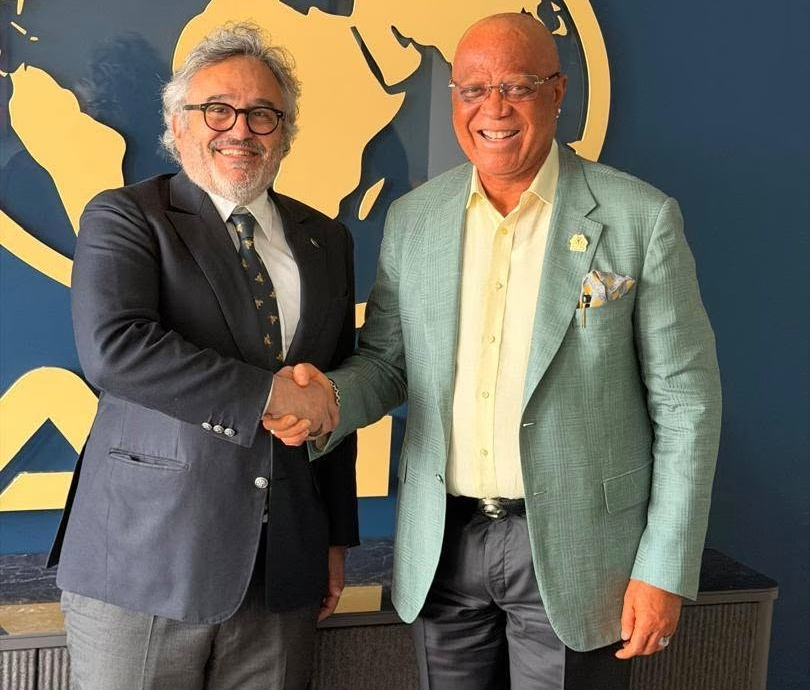
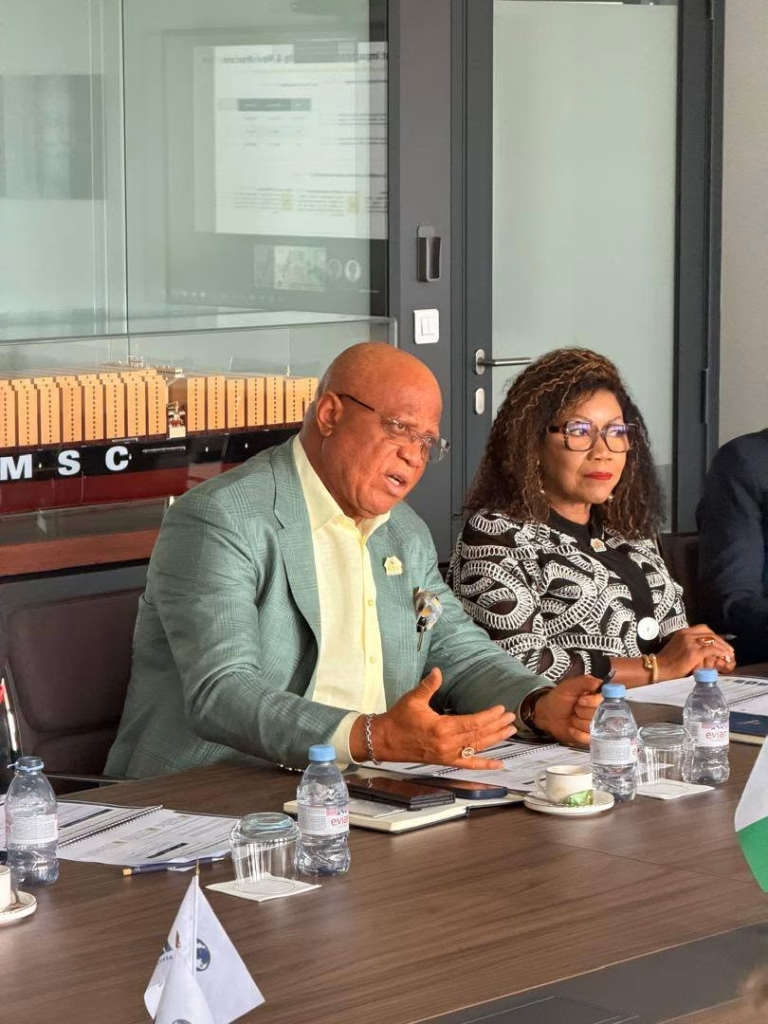
That was the significance of Governor Umo Eno’s high-level technical engagement in Paris, France, on Friday, June 5, 2026.
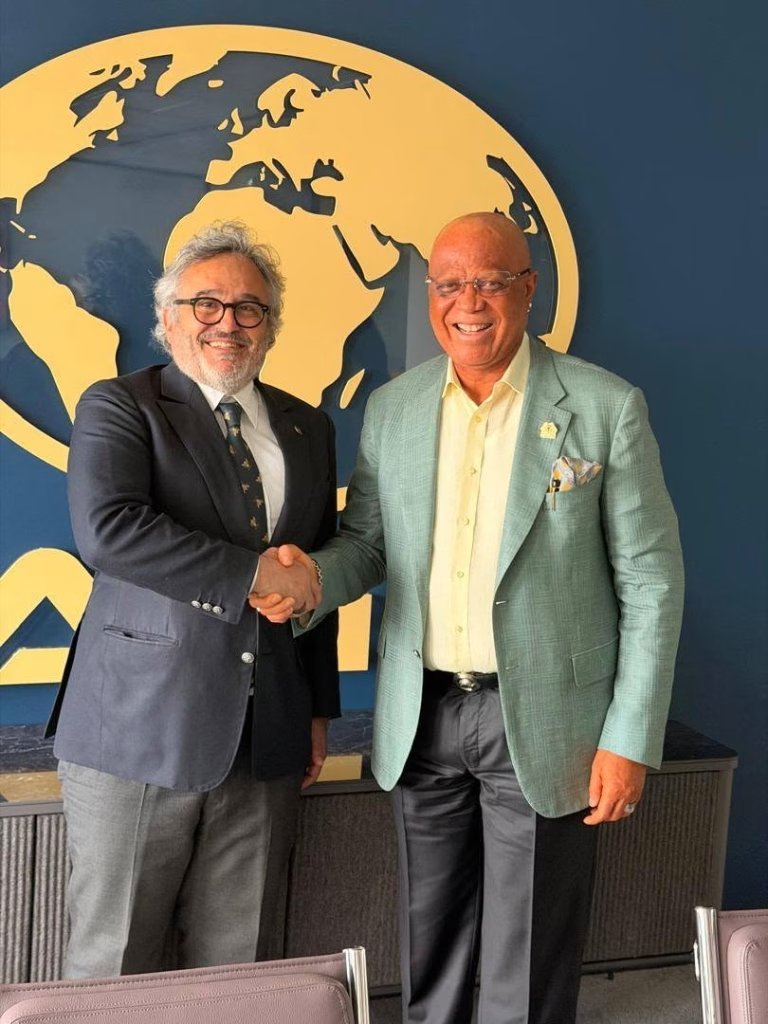
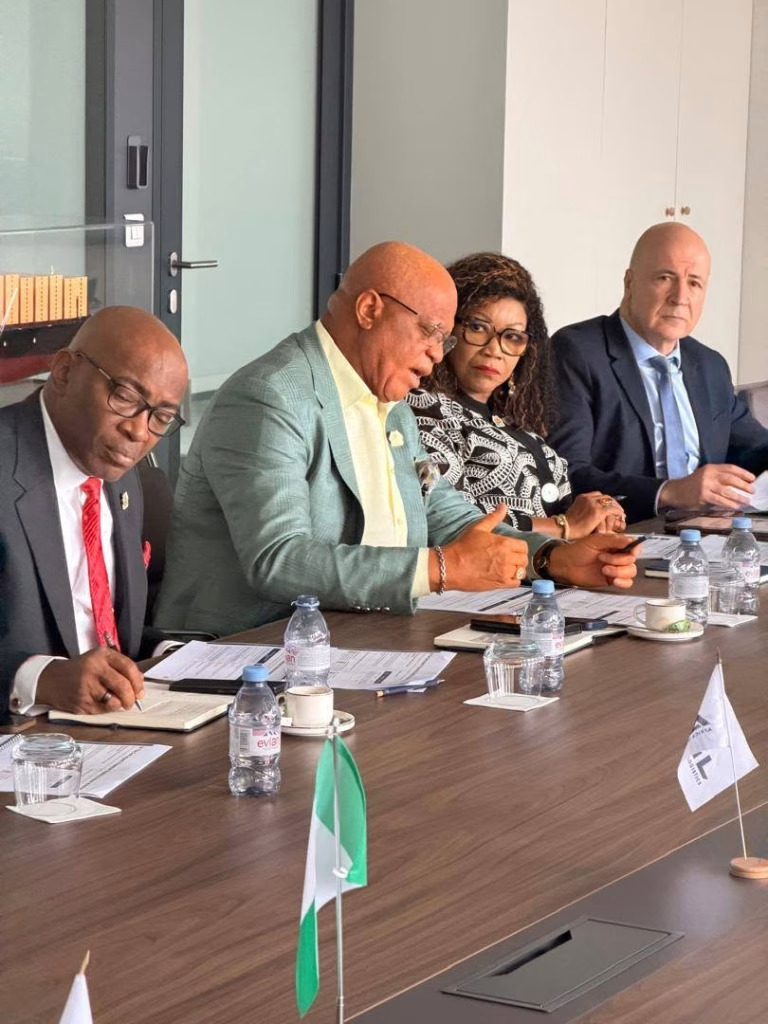
In that meeting with Africa Global Logistics Group, AGL, the Governor did not go to France for ceremony. He went with a clear message. Akwa Ibom wants movement. Akwa Ibom wants timelines. Akwa Ibom wants milestones. Akwa Ibom wants the Ibom Deep Seaport moved from planning to execution.
The meeting reviewed the Technical Feasibility Report recently submitted by Worley Parsons and examined the critical pathways for investment, implementation and long-term sustainability.
That is the language of serious infrastructure delivery.
A project of this size cannot be reduced to social media arguments. It must pass through technical validation, investor confidence, federal alignment, commercial structuring, environmental considerations, bankability tests and implementation sequencing.
Governor Eno understands this.
That is why he did not merely ask whether the project could work. He demanded accelerated development.
Imagine a trader in Aba who imports machinery parts through Lagos and spends weeks navigating port congestion, haulage uncertainty and inland movement costs. Imagine a manufacturer in Onitsha who wants faster access to maritime logistics. Imagine a young Akwa Ibom graduate who has studied logistics, engineering, maritime operations, ICT or supply-chain management but sees most of the opportunities concentrated elsewhere.
Imagine fishing communities, transport operators, warehouse owners, exporters, clearing agents, construction firms, security service providers, hospitality businesses and local contractors waiting for a new economic corridor to open.
That is what the Ibom Deep Seaport represents.
It is a gateway project.
It is a Blue Economy anchor.
It is a logistics platform.
It is an industrialisation trigger.
It is a long-term economic corridor for Akwa Ibom, the South-South, the South-East and the Gulf of Guinea.
The Ibom Deep Seaport is projected as a transshipment port designed for very large vessels, including vessels that can load more than 13,000 containers in one voyage. Smaller vessels are expected to redistribute cargo from the mega vessels to other seaports and river ports closer to consignees within and outside Nigeria.
This is why the project matters beyond Akwa Ibom. It speaks to Nigeria’s maritime future.
Recently, the Nigerian Ports Authority listed Ibom Deep Seaport among five proposed deep-seaport projects for which the Federal Government had completed approvals, certifications and compliance processes for investment and implementation. The other listed projects were Badagry Deep Sea Port, Olokola Deep Sea Port, Bakassi Deep Sea Port and Bonny Deep Sea Port.
That single development punctures the false claim that the Federal Government is not concerned about Ibom Deep Seaport. The Federal Government has not only recognised the project. It has placed it among the strategic seaports being positioned for investment and implementation.
Those who insist that the Federal Government is not involved are either not following current developments or are choosing politics over facts.
The broader federal objective is also clear. Nigeria wants to strengthen its port capacity, receive larger cargo vessels, expand trade, lower business costs, support export growth and position itself better for continental commerce under the African Continental Free Trade Area. Deep seaports are now critical because global shipping is moving towards larger vessels that require deeper draught channels.
Ibom Deep Seaport fits directly into that national vision.
Governor Eno’s role, therefore, is not to restart the project from zero. His role is to take a long-standing vision and push it into a bankable, investable and deliverable phase.
That is what he is doing.
In April 2026, he received the project’s feasibility report from the Technical Committee chaired by Mrs Mfon Usoro, a respected maritime lawyer and former Director-General of NIMASA. At that presentation, the Governor reaffirmed his administration’s commitment and noted that deliberate steps had been taken to advance the project, including funding feasibility studies, preparing investor documentation and conducting key technical assessments.
The Paris engagement was the next logical step.
A feasibility report locked in a shelf does not build a seaport. It must be tested with project partners. It must be translated into investment action. It must be tied to timelines. It must define what government will do, what investors will do, what technical partners will do and how the project will move from paper to ground.
That is why the Governor’s demand for clear timelines and actionable next steps is important.
The Ibom Deep Seaport has always required a careful Public-Private Partnership structure. The Infrastructure Concession Regulatory Commission had earlier described the project as a major PPP initiative involving the Akwa Ibom State Government, the Federal Government, the Nigerian Ports Authority and private investors. It also noted that the project aligns with the Federal Ministry of Transportation’s plan to expand Nigeria’s port capacity and with Akwa Ibom’s industrialisation agenda.
This point must be understood by every fair-minded citizen.
A deep seaport is not a village market stall.
It is not a road culvert.
It is not a classroom block.
It is not an event centre.
It is complex infrastructure requiring federal approval, maritime regulation, port design, channel planning, dredging considerations, environmental safeguards, host-community engagement, investor commitment, cargo forecast, financial close, concession structure and long-term operational viability.
Anyone who reduces such a project to political mockery does not understand infrastructure development.
Governor Eno has chosen the more responsible path. He is building confidence. He is working with technical experts. He is engaging investors. He is aligning the project with federal policy. He is demanding speed, but not recklessness.
This matters because the seaport cannot be built for applause. It must be built to work.
A port that fails after commissioning is worse than a port that takes time to structure properly. A poorly structured project becomes a burden. A well-structured project becomes an economic engine.
That is why the Paris meeting should excite every Akwa Ibom person who believes in sustainable development.
The Governor was accompanied by the Chairman of the Technical Committee on the Ibom Deep Seaport Project, Mrs Mfon Usoro; the Secretary to the State Government, Prince Enobong Uwah; the Commissioner for Science and Digital Economy, Dr Frank Ekpeyong; the Managing Director of Hensek Integrated, Engr Uwem Okoko; and other members of the state delegation.
This composition also sends a message. The project is not being treated as a mere political talking point. It is receiving technical, administrative, investment and implementation attention at the highest level of government.
For Akwa Ibom, the implications are huge.
When realised, Ibom Deep Seaport can support maritime trade, attract industrial investment, expand the logistics economy, create jobs, improve export opportunities and strengthen the state’s position as a major commercial gateway in the Gulf of Guinea.
It can also complement other strategic assets of the state, including aviation infrastructure, road expansion, industrial development, power-sector reforms and the broader ARISE Agenda of Governor Umo Eno.
This is why the opposition narrative is weak.
The facts do not support the claim that nothing is happening.
The Federal Government has listed Ibom Deep Seaport among approved deep-seaport projects for investment and implementation.
The Technical Feasibility Report has been submitted.
Governor Eno has received and reviewed the report.
The State Government has engaged project partners in Paris.
The Governor has demanded accelerated delivery.
The project partners have reaffirmed commitment.
The next stage is to convert these technical and investment engagements into structured implementation milestones.
That is how serious projects move.
Governor Umo Eno’s style may not satisfy those who prefer noise over work. But leadership is not measured by the volume of political statements. It is measured by the quality of decisions, the seriousness of engagements and the discipline to follow through.
Ibom Deep Seaport is moving.
It may not be moving at the speed of propaganda, but it is moving through the channels that matter.
From Uyo to Abuja, from technical review to investor engagement, from feasibility report to Paris working session, the project is receiving the attention required to bring it closer to reality.
Those who love Akwa Ibom should not mock a project that can redefine the state’s economy. They should ask useful questions, demand accountability, support constructive engagement and encourage every effort that moves the seaport forward.
Governor Umo Eno has made his position clear.
Akwa Ibom cannot continue to wait endlessly.
The dream must now become a deliverable project.
That was the message from Paris.
That is the meaning of accelerated development.
And that is why Ibom Deep Seaport remains one of the most important economic frontiers in Akwa Ibom’s future.
—
Citp’ Destiny Young, FIIM, MCPN, a Political and Digital Communication Expert, serves as the Special Assistant (New Media & Digital Communication) to the Executive Governor of Akwa Ibom State, H.E. Gov Umo Umo, PhD